
Hair regrowth is possible for many women, but the right approach depends on the underlying cause of hair loss and how each woman responds to treatment. The evidence-backed options range from over-the-counter minoxidil to prescription and personalized treatments guided by a medical provider, and the fastest way to a plan that fits is a professional assessment that identifies the cause first.
This guide explains what works for female hair loss, how the options compare, and how to start.
- Most common cause: female pattern hair loss (androgenetic alopecia), which thins hair at the center part and across the top of the scalp.
- FDA-approved topical: minoxidil (2% and 5%), the only over-the-counter ingredient approved for hair loss in women.
- Other medically guided options: anti-androgens such as spironolactone, personalized compounded or DNA-informed treatment, ketoconazole 2% shampoo, low-level laser therapy, and platelet-rich plasma.
- Typical timeline: first changes in about 3 to 6 months, with fuller hair often taking up to 12 months. Consistency matters.
- The key step: a professional scalp and hair analysis to match the treatment to your cause.
Can Women Actually Regrow Thinning Hair?
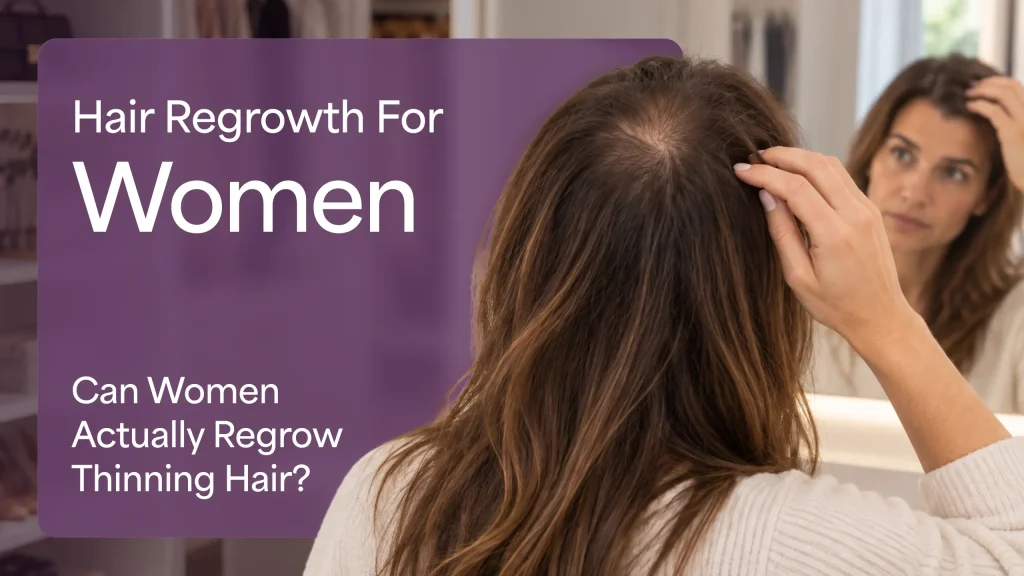
Yes, for many women, though it helps to be clear about what regrowth means. Women with thin hair often ask whether it is too late, and the answer is usually no. When a hair follicle has shrunk but is still alive, the right treatment may reactivate it and produce thicker, longer hairs again. When a follicle has been dormant for a very long time or scarred, regrowth becomes less likely. This is why early action matters: the sooner you act, the more healthy hair follicles you have to work with.
It also helps to separate two goals. Slowing or stopping loss keeps the hair you still have. Regrowth adds hair from follicles that had stopped producing visible strands. Many women want both, and a good plan is built to do both at once. Results vary from person to person, and no honest provider can promise a specific outcome, but meaningful improvement is a reasonable goal for the right candidate who starts early and stays consistent.
Why Women Lose Hair, and Why the Cause Changes the Treatment
Women may experience hair loss for several reasons, and the cause of hair loss matters because it points to the treatment that will actually help. Hair loss affects both women and men, but women often experience it differently, and reaching for a generic product before you know what causes hair loss in your case is the most common reason women feel that nothing works.
The most common pattern is female pattern hair loss, also called androgenetic alopecia. Unlike male pattern hair loss, which usually starts at the hairline and crown, female pattern baldness tends to show up as hair loss and thinning at the part line and diffuse thinning across the top of the scalp, while the hairline stays put. Both male and female pattern hair loss involve follicular miniaturization: the growth phase of the hair shortens, and each follicle produces a finer, shorter hair shaft over time until it may stop producing visible hair at all. This type of hair loss tends to progress slowly, and hair loss may go unnoticed until the part looks wider or the ponytail feels sparser.
Hormones drive several other patterns. Many women first notice hair loss around menopause, and postmenopausal women are among the most affected. Postpartum shedding, thyroid imbalances, and polyendocrine metabolic ovarian syndrome can all change the growth cycle. Telogen effluvium, a diffuse hair shedding triggered by stress, illness, surgery, or a major life event, pushes many hairs into the resting phase at once, and it often resolves once the trigger passes. Low iron and other nutritional gaps can contribute to hair loss, as can traction from tight hairstyles worn over years, which can cause permanent hair loss if the follicle is damaged.
Because these causes call for different responses, a proper diagnosis and treatment start by identifying which one, or which combination, is behind your hair loss. Your pattern of hair loss helps a specialist point to the cause. For a fuller look at how women experience hair loss differently than men, see HairClub’s guide to women’s hair loss.
Hair Regrowth Treatments for Women, and How They Work
There is no single best treatment for hair loss in women, because the right option depends on your cause, your health history, and how your body responds. The right treatment options for female pattern hair loss depend on the cause. Here are the evidence-backed hair growth treatments and how each one works.
Minoxidil for women is available as a 2% or 5% topical minoxidil solution or foam, and it is the only over-the-counter ingredient the FDA has approved to treat hair loss in women. It works by extending the growth phase of the hair and improving blood flow to the follicles, which can wake dormant follicles and produce thicker strands. It is not a quick fix. Most women need at least three to six months of consistent use to judge whether it is working, and results continue only as long as you keep using it. Some women notice temporary shedding in the first few weeks as follicles shift into a new growth phase, which is normal. To learn how to use it and what to expect, read our complete guide to minoxidil for hair loss.
Anti-androgens address hormone-driven thinning. Spironolactone, taken by prescription, blocks the effect of androgens that can shrink follicles in some women, and it is often used for hair loss related to PMOS. Ketoconazole 2% shampoo is a prescription-strength topical that helps reduce local scalp inflammation, helps to reduce local DHT levels at the hair follicle, and improves the hair growth cycle. Progesterone and certain hormone-balancing approaches may help women whose hair loss is tied to menopause or hormonal shifts. These require a licensed provider, and spironolactone is not suitable for women who are pregnant or planning pregnancy.
Oral finasteride is worth understanding clearly. It lowers DHT, the hormone most linked to pattern hair loss, but it is not FDA-approved for women and is never used during pregnancy or in a woman who could become pregnant because it can harm a developing fetus. When it is considered for women, it is prescribed off-label or as part of a compounded formula under medical supervision, and only after a provider weighs the risks and benefits for that individual.
Low-level laser therapy uses gentle light to stimulate follicles at the scalp, and it is available as in-office treatment or at-home laser caps. It is non-invasive and is sometimes combined with other treatments to promote hair growth. Platelet-rich plasma, or PRP, uses growth factors from your own blood, injected into the scalp, to encourage follicles to regrow hair. It is an in-office procedure, usually done in a series, and results build over several months.
Nutritional support has a narrow but real role. If blood tests show a deficiency in iron or another nutrient, correcting it may help your hair. Hair growth vitamins taken without a deficiency, though, rarely make a meaningful difference, so they are best used to support a plan rather than as the plan itself.
For some women with more extensive hair loss, hair transplantation is an option to consider. It moves healthy follicles from denser areas like the center area in the back of the scalp to thinning ones and, when appropriate, is performed by affiliated surgeons after an in-person evaluation. Whether you are a candidate is a question for a specialist, not something to decide from an article.
| Treatment | How it works | Best suited for | Typical timeline | Needs a provider |
|---|---|---|---|---|
| Minoxidil (topical 2% or 5%) | Extends the growth phase and boosts blood flow to follicles | Female pattern and diffuse thinning | 3 to 6 months for first changes | No, over the counter |
| Spironolactone | Blocks androgens linked to hair loss | Hormone-driven thinning, PCOS | 3 to 6 months | Yes, prescription |
| DNA-informed compounded treatment | Combines actives matched to your biology, reviewed by a provider | Women who want a plan built around their cause | 3 to 6 months, up to 12 for fuller results | Yes, medically guided |
| Low-level laser therapy | Stimulates follicles with gentle light | Mild to moderate thinning, maintenance | 4 to 6 months | At-home caps, no |
| Platelet-rich plasma (PRP) | Uses your own growth factors to stimulate follicles | Overall thinning, maintenance | 3 to 6 months, after a series | Yes, in-office |
| Hair transplantation | Moves healthy follicles to thinning areas | More extensive loss, the right candidate | Visible over several months | Yes, surgical |
Regrowth Versus Replacement: What is the Difference?
Women searching for regrowth are sometimes really looking at two different paths. Hair regrowth stimulates your own follicles to produce more hair using treatments like minoxidil, laser therapy, and personalized medical plans, and it takes months to show. Hair replacement adds volume right away through custom hair systems or scalp micropigmentation, giving the look of a full head of hair without waiting for growth.
Mild thinning can also be softened with hair styling techniques while a regrowth plan takes effect. Neither path is better in the abstract; the right choice depends on how much hair you have to work with, how quickly you want a change, and your goals. A specialist can walk you through both, including hair replacement designed for women.
Why a Personalized Plan Works Better Than a One-Size-Fits-All Bottle
If you have tried an off-the-shelf product and felt let down, the problem may not have been the ingredient. It may have been that the product was never matched to your cause in the first place. A single bottle bought online cannot tell whether your hair loss is genetic, hormonal, nutritional, or a mix, and it cannot adjust when it is not working.
A personalized plan flips that order. It starts with an assessment that identifies the cause and establishes a baseline, then builds a treatment plan that may combine more than one approach, since women often respond best to several mechanisms working together rather than one in isolation. From there, progress is measured and the plan is adjusted over time.
This is also where genetics can help, not as a way to explain why you are losing your hair, but as a way to inform which ingredients and delivery methods may respond best for you. HairClub RX, a DNA-informed personalized treatment program, uses a simple cheek swab to help guide a compounded formula that a licensed telehealth provider reviews before anything is prescribed. A compounded medication may combine actives such as minoxidil with other ingredients selected for your profile, and the program pairs treatment with sulfate-free hair care products designed to support scalp health. It is worth being precise here: while individual ingredients like minoxidil may be FDA-approved on their own, a compounded combination is not FDA-approved as a whole, and a provider decides whether it is appropriate for you. HairClub RX is available at participating U.S. locations, and it pairs the treatment with in-person support and progress tracking rather than leaving you to manage on your own.
What to Expect: Timeline and Staying Consistent
Hair regrowth is measured in months, not weeks, because hair grows on its own schedule. Many women see their first signs of change, such as less hair shedding or subtle new hair growth, within a few months of treatment. Visible regrowth often appears in less than six months for those who respond, and fuller results can take up to twelve months of steady treatment.
Consistency is the single biggest factor you control. Treatments that stimulate hair growth only keep working while you use them, so a plan you can stick with matters more than the strongest option you will abandon. This is one advantage of a monitored program: with a baseline recorded and progress checked over time, you can see whether a treatment is working and change course early instead of guessing for a year. Set realistic expectations, stay with the plan, and give it time.
How to Start Your Hair Regrowth Plan
The single most useful step you can take is also the one none of the treatment lists online can give you: a hands-on look at your hair and scalp from someone who does this every day. A professional assessment uses high-magnification analysis to measure hair density and the width of your hairs, checks scalp condition, identifies the likely cause, and records a baseline so progress can be tracked.
That is the gap between reading about options and actually improving. HairClub has focused on hair loss for nearly 50 years, with more than 100 centers across the United States, Canada, and Puerto Rico and over 500,000 clients served. A Certified Hair Loss Specialist can assess your hair in person, explain which of the options above fit your situation, and, for the right candidate, build a personalized plan that may include the DNA-informed HairClub RX program. Consultations are free, and there is no obligation to start treatment.
Ready to stop guessing?
A free consultation gives you a hands-on scalp and hair analysis and a plan matched to your cause, with no obligation to start. Book a free consultation.
Frequently Asked Questions
Can hair regrowth for women really work?
For many women, yes. Regrowth is most realistic when follicles are miniaturized rather than gone, and when treatment starts early and matches the cause. Results vary, and no outcome can be guaranteed, but meaningful improvement is a reasonable goal for the right candidate who stays consistent.
What is the best hair loss treatment for women?
There is no single best treatment for female pattern hair loss, because it depends on your cause and biology. Minoxidil is the only FDA-approved over-the-counter option for women, while hormone-driven thinning may call for prescription or personalized treatment. A professional assessment is the reliable way to find the right fit.
How long does it take to see hair regrowth?
Most women need about three to six months of consistent treatment to notice the first changes, and fuller results can take up to twelve months. Treatments work only while you keep using them, so consistency is essential.
Is hair loss in women permanent?
Not always. Some causes, such as postpartum or stress-related shedding, are temporary and resolve on their own. Pattern hair loss tends to progress without treatment, but it can often be slowed or partly reversed when a follicle is miniaturized rather than lost, which is why early treatment matters.
Do I need a prescription to regrow my hair?
Not for everything. Over-the-counter minoxidil needs no prescription. Anti-androgens like spironolactone, ketoconazole, oral medications, and DNA-informed compounded treatments require a licensed medical provider, who can also confirm the cause and rule out other conditions.
What is the difference between hair regrowth and hair replacement?
Hair regrowth stimulates your own follicles to grow more hair over time using treatments such as minoxidil, laser therapy, and personalized plans. Hair replacement adds fullness immediately through custom hair systems or scalp micropigmentation. Many women consider both, and a specialist can explain which suits your goals.