
Key Takeaways:
- Diffuse hair loss refers to widespread thinning across the scalp, while localized hair loss affects a specific area or patch.
- Different patterns usually point to different root causes, and that matters for treatment.
- Conditions like alopecia areata, telogen effluvium, and androgenetic alopecia each show up differently on the scalp.
- A dermatologist or hair loss specialist can help identify the cause and guide you toward the right treatment options.
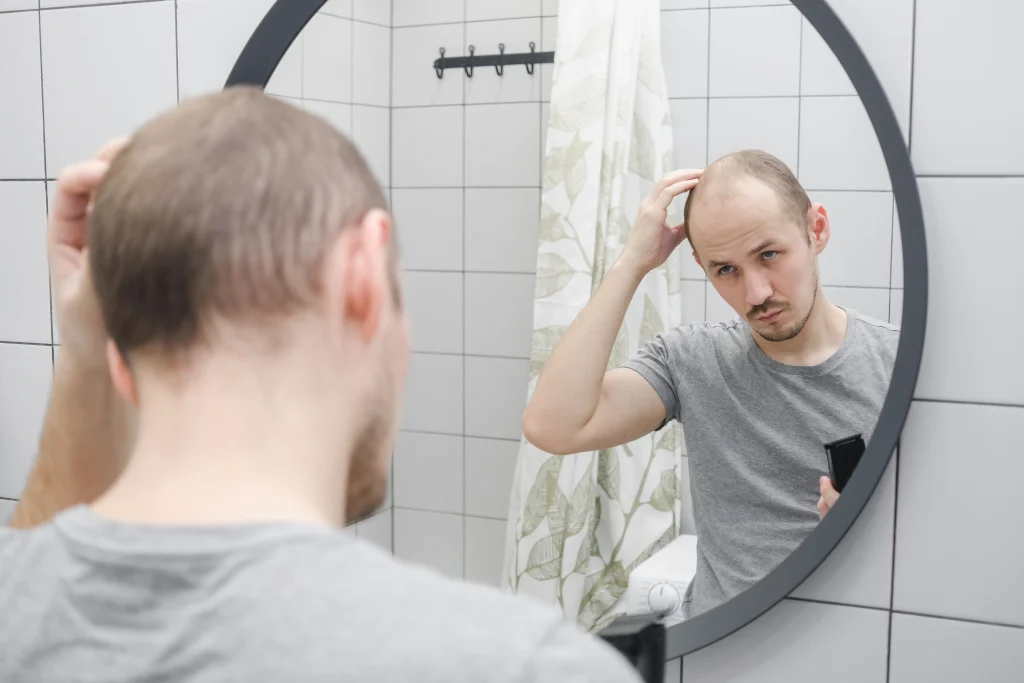
Hair loss doesn’t always look the same from person to person. Some people notice their part getting wider over time. Others find a patch where hair simply stopped growing. Some wake up to a pillow covered in hair strands with no single bald spot to show for it. These are all forms of hair loss, but they’re telling very different stories.
Understanding whether you’re experiencing diffuse hair loss or localized hair loss is one of the most useful things you can do early on. The pattern is a real clue about what’s causing the loss and what treatment options are likely to help.
What Is Diffuse Hair Loss?
Diffuse hair loss refers to a general, widespread decrease in hair density across the scalp rather than loss in one concentrated spot. Hair doesn’t fall out in patches. Instead, the scalp hair as a whole becomes thinner; you might notice it through a wider part, less volume when you style your hair, or strands that seem finer than they used to be.
People who experience diffuse hair loss often describe it as an overall thinning rather than obvious balding. The hairline may stay intact. The density is just lower everywhere or across large sections of the scalp. That’s what makes diffuse hair loss patterns harder to spot early.
A number of different underlying causes can produce this pattern, which is why diagnosing diffuse hair loss takes more than a visual check.
What Is Localized Hair Loss?
Localized hair loss affects a specific area of the scalp, a defined patch, a section of the hairline, or a concentrated zone. The clearest example most people recognize is patchy hair loss: a coin-sized or larger area where hair follicles appear to have stopped producing hair altogether.
Alopecia areata is the most well-known cause of patchy, localized hair loss. It’s an autoimmune condition where the immune system mistakenly targets hair follicles, interrupting the normal hair growth cycle in those areas. Depending on the extent, it can progress to alopecia totalis (complete scalp hair loss) or alopecia universalis (loss of all body hair), though most cases remain patchy and localized.
Other forms of localized loss include traction alopecia (caused by tight hairstyles putting chronic pressure on hair follicles) and scarring conditions that cause permanent hair loss in affected zones.
Diffuse vs. Localized Hair Loss: A Side-by-Side Look
Here’s how patchy vs diffuse hair loss typically compare across key characteristics:
| Feature | Diffuse Hair Loss | Localized Hair Loss |
|---|---|---|
| Hair Loss Pattern | Thinning across the scalp | Loss in one or more specific areas |
| Hairline Affected? | Often preserved early on | May or may not be affected |
| Common Appearance | Overall decrease in hair density | Patchy, bald spots, or defined zones |
| Typical Causes | Telogen effluvium, androgenetic alopecia, nutritional deficiency | Alopecia areata, traction, and scarring conditions |
| Hair Regrowth Likely? | Depends on cause, often yes | Depends on cause and severity |
| First Step | Blood work, scalp evaluation | Dermatologist evaluation, scalp biopsy if needed |
Common Causes of Diffuse Hair Loss
Understanding the cause of diffuse hair loss is where diagnosis really starts. Several conditions can produce this pattern, and they require different approaches.
Telogen Effluvium
Telogen effluvium is one of the most common causes of diffuse thinning, especially in women. It happens when a stressor, such as physical illness, major surgery, significant weight loss, childbirth, or emotional trauma pushes a large number of hair follicles prematurely into the resting (telogen) phase of the hair cycle. The result is excessive hair shedding that typically begins two to four months after the triggering event.
he good news: telogen effluvium is usually temporary. Once the stressor resolves, the hair growth cycle tends to normalize, and new hair begins growing back. That said, it can take six to twelve months before hair density visibly improves.
Androgenetic Alopecia
Androgenetic alopecia is the most common form of hereditary hair loss. In men, it typically shows up as thinning over the top of the scalp and a receding hairline. Female pattern hair loss usually causes thinning that appears as a widening of the center part or a look of overall thinning across the top of the scalp rather than complete bald spots, which is why it often reads as diffuse thinning rather than obvious balding.
With androgenetic alopecia, the hair growth cycle shortens over time. Hair strands become finer and shorter with each cycle until the follicle eventually stops producing visible hair. The earlier this is addressed, the more options are available.
Anagen Effluvium
Anagen effluvium causes rapid, widespread hair loss because it disrupts the hair growth cycle during the active growth (anagen) phase rather than the resting phase. Chemotherapy is the most well-known trigger. The hair loss can be severe and fast, but hair may grow back once the underlying treatment ends.
Nutritional and Hormonal Factors
Iron deficiency, thyroid dysfunction, and significant hormonal shifts (including those around menopause or postpartum recovery) can all disrupt the hair growth cycle and cause widespread hair shedding. These are often treatable once the underlying issue is identified and managed. Blood work from a healthcare provider is usually the starting point for ruling these out.
Common Causes of Localized Hair Loss
Alopecia Areata
Alopecia areata is an autoimmune condition that causes patchy hair loss on the scalp and sometimes on other areas of the body. Hair loss occurs when the immune system attacks hair follicles, interrupting normal hair growth. The patches are typically smooth and round, with no scarring or inflammation visible on the scalp.
Areata can affect anyone at any age, and its course is unpredictable. Hair may grow back on its own in some cases, while in others, treatment is required to support regrowth. A dermatologist familiar with hair disorders can help determine the best approach for your specific pattern and history of hair loss.
Traction Alopecia
Traction alopecia develops when hair is subjected to consistent tension from tight braids, weaves, extensions, or ponytails. The repeated pulling on hair follicles in areas along the hairline and temples can cause progressive hair loss over time. Caught early, traction alopecia is often reversible. Left unaddressed, it can lead to permanent hair loss in the affected zones.
Scarring Alopecia
Scarring conditions like lichen planopilaris or frontal fibrosing alopecia cause permanent hair loss by destroying the hair follicle and replacing it with scar tissue. These conditions require prompt evaluation by a dermatologist, as the damage cannot be reversed once scarring has occurred. Early diagnosis and treatment are essential to limit progression.
Signs and Symptoms: How to Tell Which Type You're Dealing With
The pattern of hair loss often gives the first clue, but it’s not always obvious without a closer look. Here are the signs and symptoms that help differentiate the two:
- Diffuse thinning: Overall decrease in hair density, wider part, scalp more visible across a broad area, finer hair strands throughout.
- Patchy hair loss: Distinct bald spots, smooth skin in the affected area, sudden onset, may affect eyebrows or other areas if alopecia areata is involved.
- Thinning over the top: Common with androgenetic alopecia, gradual, hairline often preserved initially in women.
- Diffuse hair shedding: Large amounts of hair coming out during washing or styling, noticeable on pillows or shower drain, but no single bald spot visible.
A hair pull test, where a small bundle of hair is gently pulled to assess how many strands come away, is one simple screening tool a dermatologist may use during an initial evaluation. It helps indicate whether active shedding is occurring and at what rate.
Diagnosing Diffuse and Localized Hair Loss: What to Expect
Diagnosing diffuse and localized hair loss starts with a thorough evaluation. A dermatologist or hair loss specialist will typically review your medical history, including any recent illnesses, medications, dietary changes, or significant stress events. They’ll examine your scalp visually and may use a dermatoscope (a handheld magnification tool) to assess hair follicle health, hair thickness, and scalp condition.
For diffuse patterns, blood work is often recommended to assess thyroid function, iron levels, vitamin deficiencies, and hormone levels. For localized or patchy loss, a scalp biopsy may be needed to identify inflammatory or scarring conditions.
Getting an accurate diagnosis matters more than most people realize. Treating the wrong type of hair loss with the wrong approach rarely moves the needle and can delay effective treatment.
Treatment Options: Matching the Approach to the Cause
Various treatment options exist for both diffuse and localized hair loss, but the right fit depends heavily on what’s driving the loss in the first place. There’s no single treatment that works for every type of hair loss, which is why diagnosis always comes before treatment.
For Diffuse Hair Loss
Androgenetic alopecia and telogen effluvium are the most common causes of diffuse thinning, and they respond to different interventions. For androgenetic alopecia, minoxidil3 (topical or oral) and DHT-blocking medications like finasteride or dutasteride are the most clinically supported options. These work by extending the active phase of the hair growth cycle and reducing follicle miniaturization.
HairClub RX™ is a DNA-driven program that takes personalization a step further. Rather than defaulting to a standard regimen, it uses a buccal (cheek) swab DNA6 test to identify which active ingredients, from a list that can include minoxidil, finasteride, dutasteride, spironolactone, and others, are most likely to produce results for your specific biology. A licensed, telehealth9 provider reviews your DNA results and medical history before prescribing a compounded prescription matched to your case.
The program also includes daily supplements, premium hair care products designed to support hair health, in-center hair and scalp therapeutic sessions, and quarterly progress tracking. For people dealing with diffuse thinning who want a structured, monitored approach, it’s worth asking about at a consultation.
For Localized Hair Loss
Treatment options for localized hair loss vary by cause. Alopecia areata is often treated with corticosteroid injections or topical corticosteroids to calm the immune response and encourage hair regrowth. JAK inhibitors are a newer class of treatment that has shown promising results for alopecia areata. Traction alopecia responds to removing the source of tension early. Scarring conditions require prompt dermatological care to slow progression.
For cases where hair follicles have been permanently lost, whether from scarring conditions or long-standing androgenetic alopecia, hair transplantation1 may be an option for the right candidate.
Non-Surgical Hair Replacement
For people who want immediate cosmetic coverage while addressing the underlying cause, non-surgical hair replacement options are also available. Custom hair systems can provide natural-looking results without surgery, a practical option for people with moderate to extensive hair loss
Frequently Asked Questions
What is the difference between diffuse and localized hair loss?
Diffuse hair loss refers to widespread thinning across the scalp, where overall hair density decreases without a single defined bald area. Localized hair loss affects a specific area, most commonly as patchy hair loss caused by conditions like alopecia areata or traction alopecia. The pattern matters because it points to different underlying causes and different treatment approaches.
Can diffuse hair loss grow back?
In many cases, yes. Hair may grow back after diffuse hair loss depending on what caused it. Telogen effluvium, triggered by stress, illness, or hormonal changes, is often temporary, and the hair growth cycle typically normalizes once the trigger is removed. Androgenetic alopecia is more chronic and requires ongoing treatment to maintain results. A dermatologist can help determine whether your specific cause is likely to resolve on its own or needs medical support.
What causes diffuse alopecia areata?
How do doctors diagnose diffuse hair loss?
What treatments are available for diffuse thinning?
Is localized hair loss always permanent?
Understanding Your Pattern Is the First Step
Whether you’re experiencing diffuse thinning across the scalp or a patchy area of hair loss in a specific area, the pattern you’re seeing is meaningful. It narrows down the possible causes and points toward treatment options that are actually relevant to your situation.
The challenge is that figuring out what’s actually going on usually takes more than a mirror and a Google search. A proper scalp evaluation, the right questions about your health history, and sometimes blood work or a biopsy are what get you to a real answer.
If you’ve been dealing with hair loss, a conversation with a HairClub specialist may be a good place to start. You’ll get a hair and scalp evaluation using high-magnification technology, and a realistic picture of which solutions make sense for stage of hair loss. Book your complimentary consultation today.