
If you are staring at a shelf of near-identical bottles, here is the short version. A handful of hair growth products have real clinical backing, and they work by two main routes: stimulating the follicle and its blood supply, or blocking DHT, the hormone behind most pattern hair loss. Topical minoxidil is the most studied option you can buy without a prescription.
Finasteride and dutasteride block DHT and need a prescription. For women, spironolactone and progesterone address hormonal drivers that the standard aisle ignores. Almost everything else, supplements, growth shampoos, serums, and oils, mainly supports the scalp and the look of fullness rather than regrowing hair on its own.
The insight the product carousels leave out is simple: the active ingredient matters far more than the label on the bottle, and the right products depend on your type and stage of hair loss. Two people with thinning hair can need very different combinations. The guide below grades each category honestly, then shows how to match the right products to your situation instead of buying one bottle at a time and hoping.
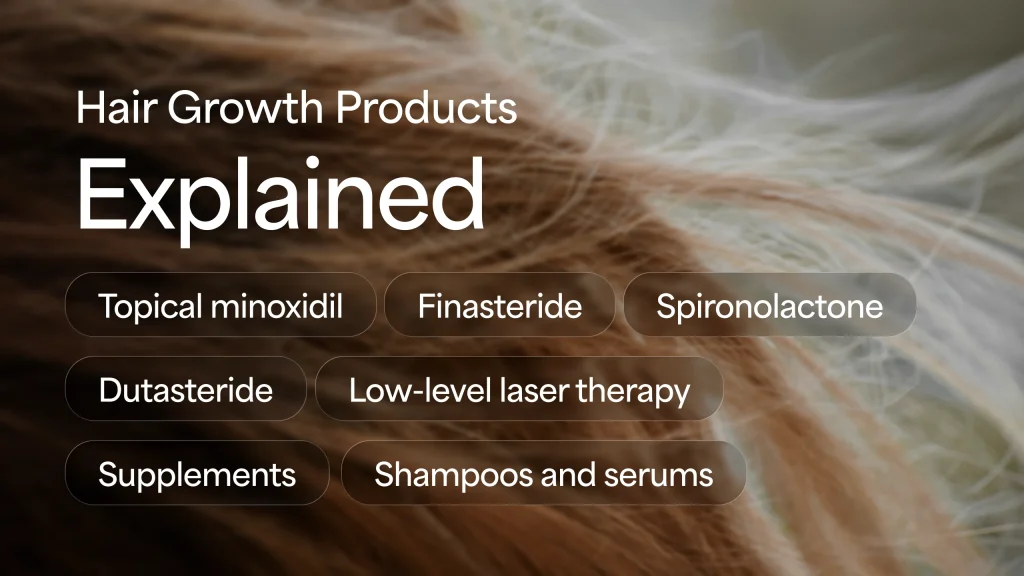
Quick Reference: Hair Growth Products at a Glance
| Product type | What it does | Evidence | Availability |
|---|---|---|---|
| Topical minoxidil | Stimulates follicles and blood flow to the scalp, extends the growth phase | Strong | Over the counter |
| Finasteride | Lowers DHT to slow loss and support regrowth | Strong | Prescription |
| Dutasteride | Dual DHT blocker for those who need more | Strong | Prescription |
| Spironolactone (women) | Blocks androgens driving hormonal thinning | Moderate | Prescription |
| Supplements | Correct a deficiency; some reduce shedding | Mixed to weak | Over the counter |
| Shampoos and serums | Support scalp health and the look of fullness | Supporting | Over the counter |
| Low-level laser therapy | Light therapy to stimulate follicles, best combined | Moderate | Device |
How to Read This Guide: Products That Regrow vs Products That Support
Not every hair growth product is trying to do the same job, and confusing the two is the fastest way to waste money. It helps to sort them into two groups. The first group can actually regrow hair or slow its loss: topical minoxidil and the DHT-blocking medications sit here, along with a few women-oriented options. The second group supports the scalp and the appearance of thicker hair: most supplements, shampoos, serums, and oils belong in this group.
Supporting products are not useless. A healthy scalp and reduced breakage make the actives that regrow hair work in a better environment. The mistake is expecting a biotin gummy or a growth serum to do what only a proven active can. As you read each category below, keep that split in mind, because it is the difference between a routine that moves the needle and one that just feels productive.
Topical Minoxidil: The Most Studied Non-Prescription Option
Minoxidil is the product most people mean when they picture a hair growth treatment, and it is the strongest option you can buy without a prescription. Sold under the brand Rogaine and many generics, it is a topical you apply to the scalp as a liquid or a foam. Researchers do not fully agree on every detail of how it works, but it is understood to increase blood flow to the follicles and to lengthen the growth phase of the hair cycle, which can thicken hairs that had started to thin.
It is one of the most effective hair loss medications for both men and women, and it is especially useful for androgenetic alopecia, the pattern thinning that is the most common cause of hair loss. It does not work for everyone: it helps to some degree in roughly two-thirds of users, and people who start earlier, before thinning is far along, tend to see the best response. Liquid and foam are similar in effect, though the foam suits sensitive scalps because it is easier to apply without the dryness some people get from the liquid.
Minoxidil does have a ceiling. It stimulates growth but does not address DHT, the hormone driving most pattern loss, which is why it is often paired with a DHT blocker. Mild scalp irritation or dryness are the usual side effects. For a full walkthrough of how to use it and what to expect month by month, see our complete guide to minoxidil for hair loss.
DHT-Blocking Medications: Finasteride and Dutasteride
If minoxidil works on the follicle, the DHT blockers work on the cause. Dihydrotestosterone, or DHT, gradually shrinks follicles in people prone to pattern baldness until they stop producing healthy hair. Lowering DHT can slow that process and, for many users, support regrowth. These are among the most effective hair loss treatments available, and both require a prescription, which is the honest answer to anyone searching for regrowth products without a prescription: the strongest topical, minoxidil, is over the counter, but the strongest systemic actives are not.
Finasteride is an FDA-approved medication for male pattern hair loss. It is most often taken as a daily pill, and a topical form exists for people who want to limit systemic exposure. Studies show most men who take it maintain or improve hair density over time. It can cause sexual and mood-related side effects in a minority of users, so it should be discussed with a medical provider before starting. Finasteride is not FDA-approved for women, though it is sometimes prescribed off-label for post-menopausal women under medical supervision.
Dutasteride blocks DHT more completely because it inhibits both enzyme types rather than one, making it an option for people who have not responded well enough to finasteride. The stronger effect can come with a higher chance of similar side effects, so it is a decision to make with a provider rather than on your own. The takeaway across this category is that DHT blockers are powerful but individual suitability, dose, and monitoring matter, which is exactly the kind of judgment a product label cannot give you.
Hair Growth Products for Women
Most best-of lists quietly assume a man is reading, which leaves women with advice that skips their most useful options. Women can use minoxidil, and it is a sensible first step for female-pattern thinning. But hormonal drivers often call for different actives. Spironolactone, taken as a pill, blocks the androgen receptors involved in hormonal thinning and can help women whose loss is androgen-driven. Progesterone is sometimes used to help balance the hormonal picture, particularly around menopause. Both are prescription decisions that depend on a woman’s health history.
Timing matters too. Postpartum hair loss is common and usually temporary: it reflects the shift in hormones after pregnancy and typically settles as levels stabilize over several months, so aggressive treatment is rarely the answer. Because women’s hair loss has more possible causes, from thyroid changes to nutrient deficiencies, a professional assessment is worth more here than any single product. The right hair growth products for a woman depend on why her hair is thinning, not on which serum is trending.
Supplements: What the Evidence Actually Says
Supplements are where honest grading matters most, because this is the category retailers push hardest and evidence supports least. Biotin is the headline example: despite its reputation, biotin has not been shown to grow hair in people who are not deficient, and true biotin deficiency is uncommon. Collagen is gentler on the wallet than the claims suggest: it may improve the condition of existing hair, but evidence that it grows new hair is inconclusive.
Multi-ingredient nutraceuticals such as Nutrafol and Viviscal sit slightly higher on the evidence scale. Some studies report less shedding and modestly improved growth for certain users, often through botanicals like saw palmetto, a plant compound thought to have a mild DHT-blocking effect. Even so, these are not universally recommended, and they are not a substitute for a proven active. The sensible rule: if lab work shows a genuine deficiency in something like iron, vitamin D, or zinc, correcting it can help; otherwise, treat supplements as a possible support, not the main event.
Shampoos, Serums, and Scalp Products
Growth shampoos, density serums, and scalp treatments are the most visible hair growth products on any shelf, and the most misunderstood. A good shampoo and conditioner keep the scalp clean and the hair less prone to breakage, which is a real benefit, and sulfate-free formulas are gentler on an irritated scalp. Ingredients like caffeine and peptides show up in serums with some early support for scalp stimulation and the look of fuller hair. A dropper serum applied to the scalp can be a pleasant, non-greasy addition to a routine.
What these products generally cannot do is regrow hair on their own. Rosemary oil is a popular natural example: small studies have compared it to minoxidil with interesting results, but the evidence is still limited, and an oil is best seen as scalp support rather than a standalone fix. The way to think about this whole category is as the supporting cast. Use a serum or a scalp-health shampoo to create better conditions, and pair it with a proven active if your goal is regrowth rather than maintenance.
Devices: Low-Level Laser Therapy and Red Light
Beyond bottles, low-level laser therapy is a product category of its own. Also called red light therapy, LLLT uses low-intensity light to stimulate follicles at the scalp, and it is drug-free and painless, which appeals to people who want to avoid medications. It is available as at-home caps and combs used a few times a week, and it tends to work best as part of a combined routine rather than alone. Results are gradual and, like every option here, depend on consistency. For the right candidate, a laser cap can complement topical and prescription actives rather than replace them.
The Problem with Buying Hair Growth Products One at a Time
Notice what every section above has in common: the right choice depends on you. Which active, at what strength, in what combination, for your type and stage of loss, and whether you are a man or a woman. A shelf of products cannot answer that, and neither can a one-bottle-fits-all subscription that ships the same formula to everyone. This is why so many people cycle through products for a year, changing one variable at a time, and conclude that nothing works, when the real issue was the combination rather than any single bottle.
The reader who has made it this far usually does not need another product recommendation. They need a way to know which of these actually apply to them, and how to combine them safely. That is a different kind of help than a listicle can offer, and it is where a personalized plan changes the equation.
A Personalized Path: HairClub RX
HairClub RX is built around that exact problem. Instead of guessing, it starts with a simple cheek swab that analyzes your DNA, and a licensed telehealth provider reviews your health history alongside those results to determine which actives suit you. If appropriate, the provider prescribes a compounded medication that can combine proven ingredients, such as minoxidil and finasteride, at strengths matched to you rather than a single off-the-shelf dose.
The program is designed to work as a whole. It pairs the compounded prescription with daily supplements, a sulfate-free shampoo, conditioner, and elixir for scalp health, and an optional laser cap when a specialist decides it would help. What sets it apart from an online-only service is the human side: an in-person HairClub specialist performs a hands-on hair and scalp analysis, sets a baseline, and tracks your progress at regular check-ins, with support from more than 100 locations and 50 years behind the brand. It is the combination-and-personalization answer the shelf cannot give.
See whether a personalized plan fits your hair loss. Book a free HairClub RX consultation and get recommendations based on an in-person analysis, not a guess.
HairClub RX is available at participating US locations. A compounded treatment is not FDA-approved, and the FDA does not evaluate the safety or effectiveness of compounded drugs, though individual ingredients may be FDA-approved. Results may vary. See the important safety information in the annex and at hairclub.com/rx-terms-and-safety.
How to Choose the Right Hair Growth Products for You
If you take one thing from this guide, let it be this: match the product to the cause, then commit. A quick framework:
- Start with the type and stage. Early pattern thinning responds best; the sooner you start a proven active, the more you have to protect.
- Separate regrow from support. Anchor your routine on a proven active (minoxidil or a DHT blocker), and treat serums, shampoos, and supplements as support.
- Account for sex and hormones. Women should factor in hormonal drivers and postpartum timing rather than defaulting to men’s advice.
- Respect the timeline. Give any product 3 to 6 months of consistent use, and up to 12 months for the fuller effect, before judging it.
- Get an assessment when it is unclear. If you cannot tell what is driving your loss, a professional evaluation saves months of trial and error.
For the wider set of options beyond products, including non-drug and surgical routes, see Hair Loss Treatments 101. For men who want method-by-method detail, see 5 proven hair regrowth methods for men.
Frequently Asked Questions
What are the most effective hair growth products?
The options with the strongest evidence are topical minoxidil and the DHT-blocking medications finasteride and dutasteride, plus spironolactone for women with hormonal thinning. Supplements, shampoos, and serums can support scalp health and the look of fullness, but they rarely regrow hair on their own.
Do hair growth products work without a prescription?
Yes. Topical minoxidil is the strongest option you can buy over the counter, and it works for both men and women. Several of the most effective actives, including finasteride, dutasteride, and spironolactone, require a prescription and medical oversight.
Which hair growth products work for women?
Women can use minoxidil, and hormonal thinning may respond to prescription options like spironolactone or progesterone. Postpartum shedding is usually temporary. Because women’s hair loss has many possible causes, a professional assessment is the most useful first step.
How long do hair growth products take to work?
Most need consistent daily use before you see a change. Expect roughly 3 to 6 months for visible improvement and up to 12 months for the fuller effect. Sticking with one plan matters more than switching products.
Do biotin or collagen supplements regrow hair?
Biotin has not been shown to grow hair in people who are not deficient, and collagen evidence for regrowth is inconclusive. If lab work shows a genuine deficiency, correcting it can help; otherwise, treat these as possible support rather than a regrowth product.
Are hair growth serums and shampoos worth it?
They can support a healthy scalp and reduce breakage, which helps the products that do regrow hair work in a better environment. On their own, most do not regrow hair, so use them alongside a proven active rather than instead of one.
Is minoxidil or finasteride better?
They do different jobs. Minoxidil stimulates the follicle, and finasteride lowers DHT to slow loss at the source, so they are often used together. The right choice depends on your type of loss and medical suitability, which is worth confirming with a provider.
Take the next step toward fuller hair
The best hair growth products are the ones matched to why your hair is thinning, used consistently, and combined sensibly. If you would rather not guess your way through a year of bottles, a personalized plan can point you to what actually applies to you.
Book a free HairClub RX consultation to get a hands-on hair and scalp analysis and a plan built around your results.