
Spironolactone is prescribed off-label for hormone-driven hair loss in women. Here is what the clinical research shows about how well it works, who it suits, and what to expect from it.
MEDICAL ADVISOR REVIEW: Opening answer block. Off-label characterization and the headline efficacy figure. This paragraph is the featured snippet target and will be quoted without surrounding context.
Spironolactone is an oral anti-androgen prescribed off-label for female pattern hair loss. In the largest pooled analysis to date, hair loss improved in 56.60% of women treated, rising to 65.80% when spironolactone was combined with another therapy and falling to 43.21% for oral spironolactone alone (Cureus, 2023). It is not FDA-approved for hair loss, and it only helps when the underlying hair loss is androgen-driven.
MEDICAL ADVISOR REVIEW: Key Takeaways box. Six condensed clinical claims. Each line must survive review independently of the body copy.
Key Takeaways
- Spironolactone is a medication approved for high blood pressure, heart failure, and fluid retention. Its use to treat hair loss is off-label.
- Pooled data across studies show 56.60% of women improved, 65.80% with combination therapy, and 43.21% on spironolactone alone. In the same analysis, 37.80% saw no improvement or only modest improvement (Cureus, 2023).
- Published dosing ranges from 25 mg to 200 mg daily, averaging around 100 mg (JAAD, 2020).
- Reduced hair shedding usually comes first. Changes in hair density are generally assessed after six months, with the best results reported at nine to twelve months.
- It works only for androgen-driven hair loss. It does not address shedding caused by stress, illness, chemotherapy, or nutritional deficiency.
- Spironolactone is contraindicated in pregnancy. Reliable contraception is required for anyone who could become pregnant (StatPearls).
MEDICAL ADVISOR REVIEW: Approved indication list and off-label framing.
What Spironolactone Is and Why It Is Used for Hair Loss
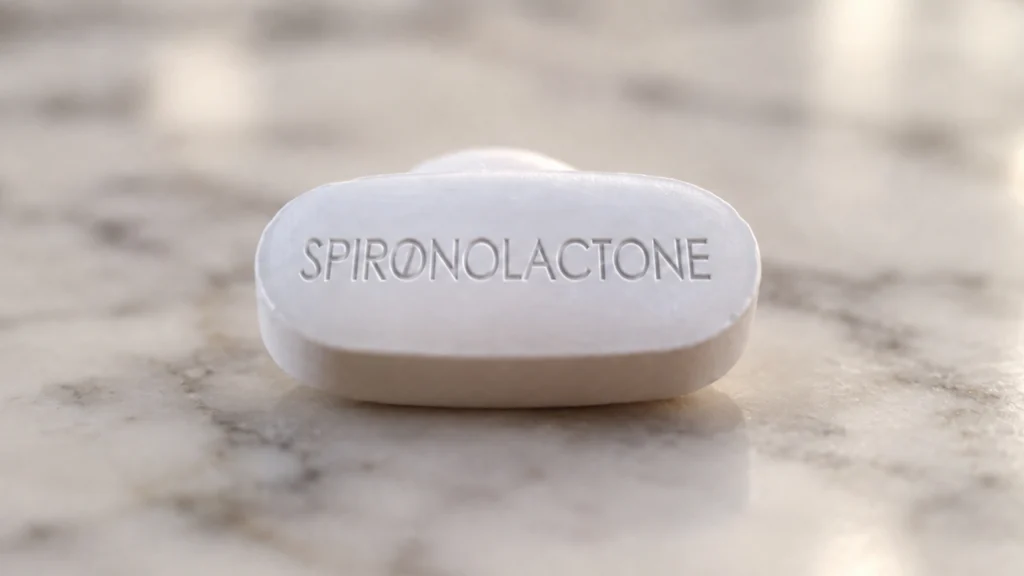
Spironolactone, sold under the brand names Aldactone and CaroSpir, is an aldosterone antagonist and a potassium-sparing diuretic. The FDA has approved it for high blood pressure, heart failure, primary hyperaldosteronism, and the fluid retention that comes with liver and kidney disease (DailyMed).
Hair loss is not on that list. Dermatology adopted spironolactone for a secondary property of the drug: it blocks androgen receptors. That anti-androgen effect made it useful across a set of hormone-driven skin and hair conditions, including acne, hirsutism, and female pattern hair loss (Actas Dermo-Sifiliográficas, 2020).
Off-label prescribing is lawful and routine in dermatology. It does mean, though, that there is no FDA-approved dose for hair loss, no manufacturer guidance written for this use, and a smaller evidence base than you would find for a drug developed specifically to treat hair loss. That context matters when you are weighing your options.
MEDICAL ADVISOR REVIEW: Mechanism of action. Androgen receptor inhibition, DHT binding reduction, partial 5-alpha-reductase suppression, follicle miniaturization claim.
How Spironolactone Works for Hair Growth
Androgens play a central role in regulating hair growth, hair follicle health, and sebum production (Int J Mol Sci, 2020). In androgenetic alopecia, sensitive hair follicles respond to those androgens by miniaturizing: each growth cycle produces a shorter, finer hair than the one before, until the follicle stops producing a visible hair at all (Br J Dermatol, 2006). If you are not sure whether that is what is happening to you, our guide to hair miniaturization explains the signs.
Spironolactone interrupts that process. It competitively inhibits androgen receptors, which reduces the binding of dihydrotestosterone to the follicle, and it partially suppresses 5-alpha-reductase activity. The combined effect is less sebum production and less miniaturization of hair follicles (Cureus, 2023).
The distinction that explains everything else. Spironolactone does not stimulate hair growth the way minoxidil does. It removes a suppressive signal. That is why stabilization comes before regrowth, why the timeline is measured in months rather than weeks, and why combination therapy consistently outperforms spironolactone on its own.
MEDICAL ADVISOR REVIEW: Highest-risk section. Every efficacy figure, sample size, and study characterization.
Does Spironolactone Work for Hair Loss? What the Research Shows
Three studies carry most of the weight here. The largest is a 2023 systematic review and meta-analysis titled The Efficacy and Safety of Oral Spironolactone in the Treatment of Female Pattern Hair Loss, which pooled the available research on the efficacy and safety of oral treatment in women (Cureus, 2023).
| Study | Design | What It Found |
|---|---|---|
| Systematic review and meta-analysis, Cureus, 2023 | Pooled randomized and observational studies of oral spironolactone in female pattern hair loss | Hair loss improved in 56.60% overall, 65.80% with combination therapy, and 43.21% with monotherapy. Hair loss did not improve or improved only modestly in 37.80% of patients. |
| Randomized, double-blind, placebo-controlled pilot, Int J Womens Dermatol, 2025 | 48 premenopausal women aged 21 to 45, spironolactone 100 mg or placebo for 24 weeks, with both groups using 3% topical minoxidil | Moderate-to-marked improvement in 38% of the spironolactone group versus 9% on placebo. Terminal hair counts rose more in the spironolactone group, though that difference approached rather than reached statistical significance. |
| Retrospective study, JAAD, 2020 | Adult women prescribed spironolactone for female pattern hair loss over a four-year period | Average dose 100 mg daily, range 25 to 200 mg, taken for at least six months. Confirms real-world prescribing patterns. |
An earlier retrospective study of 166 women found stabilization or improvement in roughly three-quarters of patients, with a stronger response among women who also had acne or hirsutism (JAAD, 2015). Women with those co-occurring symptoms tend to have more pronounced androgen activity, which is consistent with how the drug works.
The honest reading is this. For the right candidate, spironolactone may reduce hair shedding, improve hair density, and support some hair regrowth, and a proportion of women do end up with visibly thicker, fuller hair.
The 2023 review concluded that spironolactone is an effective treatment option for hair loss, and that is a fair summary as long as the conditions attached to it stay in view. The effect is real but modest, and the research is heterogeneous enough that individual response varies widely. Roughly four in ten women in the pooled data did not get a meaningful result. That is not a reason to dismiss it as a treatment for hair loss. It is a reason to establish whether you are in the group it can help before committing to a year of it.
MEDICAL ADVISOR REVIEW: Candidacy criteria and the list of conditions spironolactone does not address. Confirm no statement reads as a diagnosis.
Who Spironolactone Actually Helps
Female pattern hair loss is the most common form of hair loss in women (Clin Interv Aging, 2007), and it is the condition spironolactone is prescribed for. Written as female-pattern hair loss in much of the literature, it is the female presentation of androgenetic alopecia. Androgenetic alopecia in women shows up as diffuse hair thinning across the top of the scalp and widening of the center part, usually with the frontal hairline preserved, which is why hair loss patterns in women look so different from the receding hairline associated with men. Our overview of women’s hair loss covers those differences in more detail.
The strongest candidates
Premenopausal women with female pattern hair loss are the clearest fit. The condition is androgen-driven, the drug targets androgens directly, and the safety profile in this group is reasonably well characterized. Women who also have acne or hirsutism often respond particularly well, and here spironolactone can help on two fronts at once, since spironolactone treats those symptoms alongside the hair loss.
Where response is less predictable
After menopause, hair loss in women has a less androgen-dependent component, and response rates tend to be lower. Dosing is also more cautious in older patients because the risk of high potassium rises with age. Low-dose protocols have been studied for exactly this reason: one review of 62 women treated at 50 mg daily or less, at an average dose of about 35 mg and an average age of 62, looked specifically at patients who could not tolerate higher doses (JDD, 2024). That work looked specifically at the tolerability of spironolactone in patients who could not manage standard dosing, and the group included women with frontal fibrosing alopecia alongside female pattern hair loss.
Where spironolactone does not help
This is the part most articles skip. Spironolactone addresses hair loss caused by androgens. It does nothing for hair loss with a different cause, including:
- Telogen effluvium, the diffuse shedding that follows illness, surgery, childbirth or significant stress
- Hair loss from iron deficiency or other nutritional shortfalls
- Thyroid-related shedding
- Chemotherapy-related hair loss
- Traction alopecia from tension on the hair
- Alopecia areata, which is autoimmune rather than hormonal
Several of these can occur alongside female pattern hair loss, which is part of why self-assessment is unreliable. Choosing a hair loss treatment before establishing the cause is how people lose critical time in proper treatment initiation and desired response. If you are still working out which category you are in, start with the root causes of hair loss and the differences between the main types of alopecia. Distinguishing between these forms of female hair loss involves the pattern of loss, a magnified look at whether hair follicles are actually miniaturizing, and bloodwork covering iron, thyroid, and androgen levels.
A HairClub Certified Hair Loss Specialist can perform a hair and scalp analysis under high magnification to establish what is happening at the follicle level, which is the step that determines whether a hormone treatment is a sensible option for women in the first place.
MEDICAL ADVISOR REVIEW: All dose figures, titration description and the non-recommendation disclaimer. Legal review also required.
Spironolactone Dosage for Hair Loss
Because it is not FDA-approved for this use, there is no official spironolactone dosage for hair loss. Providers who use spironolactone for this purpose set the dose from published practice rather than from a label. The figures below are what studies report, not a recommendation.
| Approach | Typical Range | Context |
|---|---|---|
| Starting dose | 25 mg daily | Prescribers commonly start low and titrate upward to limit the risk of side effects. |
| Standard target | 100 mg to 200 mg daily | The dose most often used for hair loss. The average in one retrospective study was 100 mg daily (JAAD, 2020). |
| Low-dose route | 50 mg daily or less | Studied in patients who cannot tolerate standard dosing and in older patients at higher risk of high potassium (JDD, 2024). |
| Upper end | 200 mg daily | The high end of reported hair loss dosing. Not a starting point. |
Spironolactone can cause drowsiness, so it is often taken in the evening, and it can be taken with or without food. Anyone taking spironolactone for hair loss should have the dose reviewed against their medical history, blood pressure, kidney function, and other medications. Spironolactone treatment is set by a prescriber, not chosen from a range.
MEDICAL ADVISOR REVIEW: Timeline bands and the early shedding explanation.
How Long Spironolactone Takes to Work
Longer than most people expect. Clinical trials in this area have generally run from six to twenty months, which tells you something about the horizon involved. The reason is the hair growth cycle itself: a follicle that resumes normal function still has to grow a hair out to visible length before you see anything change.
| Period | What Usually Happens |
|---|---|
| Weeks 1 to 8 | Some people notice increased hair shedding. This reflects the growth cycle resetting rather than the drug causing hair loss. |
| Months 3 to 6 | Shedding typically settles. This is stabilization, not regrowth, and it is easy to mistake for nothing happening. |
| Around month 6 | The earliest point at which changes in hair density are usually worth assessing. |
| Months 9 to 12 | Where the best results tend to appear. Most prescribers will not call a treatment a failure before twelve months. |
The month four problem. Four months in, shedding has settled but nothing looks visibly different in the mirror. This is the point at which a lot of people stop a treatment that is working. The reason it is so hard to sit through is that there is usually nothing to compare against. Without a baseline measurement of hair density and shaft width, stabilization and stagnation look identical. They are not the same thing, and for a progressive condition, holding ground is a result.
MEDICAL ADVISOR REVIEW: Combination efficacy figures and the 2026 safety cohort characterization.
Spironolactone and Minoxidil: Why They Are Usually Prescribed Together
Spironolactone is commonly prescribed alongside minoxidil, and the two are not alternatives to each other. Spironolactone blocks androgens at the receptor. Minoxidil opens potassium channels at the follicle and extends the growth phase of the hair cycle. Different mechanisms, so stacking them is not redundant.
The data supports it. In the pooled analysis, the combination therapy group improved at 65.80% against 43.21% for monotherapy (Cureus, 2023). A separate trial found improvement in 43% of women after four months on a combination of spironolactone and minoxidil, with no serious adverse events reported (J Cosmet Dermatol, 2023).
This is also why the 2025 placebo-controlled trial is worth reading carefully. Both arms used topical minoxidil, so what it measured was the value of adding spironolactone on top, not spironolactone in isolation (Int J Womens Dermatol, 2025).
Low-dose oral minoxidil is sometimes used instead of the topical version. A 2026 retrospective cohort of 432 patients on that combination found adverse effects were generally mild and manageable, with a higher risk of blood-pressure-related symptoms in patients already taking other drugs that affect blood pressure (JAAD, 2026). If you want the detail on the other half of this pairing, our guide to minoxidil for hair loss covers it.
MEDICAL ADVISOR REVIEW: Entire section. Adverse event percentages, hyperkalemia framing, monitoring guidance and the pregnancy contraindication wording. Legal review also required.
Side Effects, Risks and Monitoring
The potential side effects of spironolactone are mostly dose-related and mostly manageable, but the range reported across studies is wide.
Across the studies included in the analysis, reported side effects varied. The most commonly reported were scalp itching or increased flaking (18.92%), menstrual disorders (11.85%), and facial hypertrichosis, or increased facial hair growth (6.93%). About 2.79% of participants discontinued treatment (Cureus, 2023). The 2025 placebo-controlled trial reported menstrual irregularities in 37.5% of the spironolactone group, significantly higher than placebo (Int J Womens Dermatol, 2025). Menstrual side effects are a genuine limiter, and the range across studies is wide.
Other commonly reported effects include breast tenderness, increased urination, dizziness, low blood pressure, fatigue, headache, and reduced libido. The full safety profile for the drug sits in its FDA prescribing information.
High potassium
Spironolactone is potassium-sparing, so it can raise blood potassium levels. High potassium can affect the heart and is the most serious risk associated with the drug (StatPearls). Risk is higher with age, with kidney impairment, and when taking potassium supplements, other diuretics, or ACE inhibitors. Prescribers typically check potassium and kidney function with bloodwork, and the frequency depends on your risk profile.
Blood pressure
Because the drug lowers blood pressure, anyone taking it for hair loss who does not have high blood pressure to begin with should have their blood pressure monitored, particularly in the early months.
Pregnancy
Spironolactone must not be taken during pregnancy. Its anti-androgen activity can affect a developing fetus. Anyone who could become pregnant needs reliable contraception throughout treatment. If you are pregnant, planning a pregnancy or breastfeeding, tell your prescriber before starting (StatPearls).
MEDICAL ADVISOR REVIEW: Hypertrichosis attribution. Causality between spironolactone and unwanted hair must not be overstated.
Can Spironolactone Cause Unwanted Hair Growth?
This question comes up a lot, and the general answer is the opposite of what people fear. Spironolactone is an anti-androgen, and it is prescribed to reduce unwanted facial and body hair in hirsutism (Actas Dermo-Sifiliográficas, 2020). It works against the hormones that cause hair to grow in androgen-sensitive areas of the face and body, while helping hair on the scalp.
The honest nuance is that facial hypertrichosis was still reported as an adverse event in 6.93% of patients across the pooled studies (Cureus, 2023). It is also worth knowing that when spironolactone is combined with low-dose oral minoxidil, hypertrichosis is a recognized effect of that combination, and the 2026 cohort study looked specifically at how initiation timing relates to that risk (JAAD, 2026).
The reverse question also comes up: can spironolactone cause hair loss? Some people shed more in the first weeks. That is the hair cycle resetting as follicles move from resting to growing, not the drug causing loss.
MEDICAL ADVISOR REVIEW: Gynecomastia claim and the statement that spironolactone is generally not recommended in men.
Spironolactone for Men
Spironolactone is rarely used for male pattern baldness. Its anti-androgen activity at the doses used for hair loss lowers testosterone, which can cause gynecomastia, the development of breast tissue, along with reduced libido. For that reason it is generally not recommended in men (Dermatol Clin, 2010). The established route for men runs through 5-alpha-reductase inhibitors instead, which we cover in our comparison of dutasteride and finasteride, alongside topical or oral minoxidil.
MEDICAL ADVISOR REVIEW: Evidence-strength hedge on topical formulations. Confirm the hedge is strong enough.
Topical Spironolactone
Compounded topical spironolactone exists, and the rationale is straightforward: apply the drug at the scalp to concentrate it where it is needed while reducing systemic exposure. The evidence base is much thinner than for the oral form. The 2023 systematic review and meta-analysis explicitly excluded studies using topical spironolactone from its pooled analysis, which reflects how little comparable data there is (Cureus, 2023). Treat it as an area of clinical interest rather than an established alternative to oral treatment.
MEDICAL ADVISOR REVIEW: All HairClub RX claims against the Product Research Extraction and Backgrounder. Confirm route-neutral phrasing and that all four required disclaimers are present and correctly worded.
How HairClub Approaches Hormonal Hair Loss
If there is one thing worth taking from everything above, it is that spironolactone is conditional. It helps a specific kind of hair loss, and the useful question is not whether the drug works on average but whether it is likely to work for you.
HairClub starts with measurement rather than a prescription. Within the hair loss prevention and regrowth program, a Certified Hair Loss Specialist performs a hands-on hair and scalp analysis under high magnification, recording hair density and shaft width and assessing scalp condition. That reading becomes your baseline, and it is what makes the difference between guessing at your progress and tracking it.
HairClub RX™ builds on that with DNA testing. A cheek swab is analyzed to determine which active ingredients are most likely to suit your profile, and the report includes an antiandrogenic group covering spironolactone alongside dutasteride, finasteride, saw palmetto, and melatonin.
A licensed telehealth provider then reviews your medical history and the laboratory recommendation and, if appropriate, prescribes a compounded medication that may include up to 12 active ingredients matched to you. Whether spironolactone is part of that formula is a clinical decision made by the provider, not a fixed feature of the program.
Because the evidence favors combination over monotherapy, a compounded approach fits the research rather than working around it. From there, quarterly in-person progress tracking measures you against your own baseline, which is the practical answer to the month four problem described earlier. The program also includes daily supplements, sulfate-free hair care products, and in-center hair therapy sessions, with an optional laser cap for some clients depending on their situation. It sits within a broader set of hair restoration options, so if a hormone-driven treatment turns out not to be the right fit, it is not the only route available.
Important information. The DNA test was developed and its performance characteristics determined by GX Sciences. It has not been cleared or approved by the FDA. The laboratory is regulated under CLIA and qualified to perform high-complexity testing. The HairClub RX program involves a licensed telehealth provider who will review an individual’s specific case and, if appropriate, prescribe a compounded medication to meet the specific needs of that individual. While each pharmaceutical ingredient, individually, may be approved by the Food and Drug Administration, the combination may not. A compounded treatment is not FDA-approved, and FDA does not evaluate the safety or effectiveness of compounded drugs. HairClub RX is available at participating locations only. Results may vary.
MEDICAL ADVISOR REVIEW: All eight answers. FAQ content is the most likely to be surfaced without surrounding context by AI Overviews and featured snippets.
Frequently Asked Questions
Is spironolactone FDA-approved for hair loss?
No. It is approved for high blood pressure, heart failure, primary hyperaldosteronism, and fluid retention (DailyMed). Using spironolactone for hair loss is off-label, which is lawful and common in dermatology. It does mean there is no officially approved dose for this use and a smaller evidence base than for an approved indication.
Does spironolactone help with hair loss in women?
For many women it does, provided the hair loss is androgen-driven. Pooled data shows improvement in 56.60% of women overall (Cureus, 2023), and an earlier retrospective study found stabilization or improvement in roughly three-quarters of patients (JAAD, 2015). It does not help with hair loss that has a non-hormonal cause.
How long does spironolactone take to work for hair growth?
Reduced hair shedding is usually the first change, generally within the first few months. Changes in hair density are typically assessed from around six months, with the best results reported between nine and twelve months. Trials in this area have run from six to twenty months (Actas Dermo-Sifiliográficas, 2020), so judging it before a year is premature.
What is the usual spironolactone dosage for hair loss?
Published studies report an average of about 100 mg daily with a range of 25 mg to 200 mg (JAAD, 2020), most often landing in the 100 to 200 mg band. Prescribers commonly start at 25 mg and titrate upward. Low-dose protocols of 50 mg daily or less have been studied where tolerability or age-related risk is a concern (JDD, 2024). Dosing is set by a prescriber based on your medical history.
Can spironolactone cause hair loss when you first start?
Some people notice increased shedding in the first weeks after starting spironolactone. This reflects the hair growth cycle resetting rather than the drug causing hair loss. It is also the point at which many people stop a treatment that is beginning to work, so it is worth expecting.
Does spironolactone work for postmenopausal women?
It is used after menopause, but response rates are generally lower because pattern hair loss at that stage has a less androgen-dependent component. Dosing tends to be more cautious as the risk of high potassium rises with age, which is part of why low-dose protocols have been studied in older patients (JDD, 2024).
Will my hair fall out again if I stop taking spironolactone?
Any benefit depends on continued use. If you stop, the underlying androgen-driven process resumes and gains are generally lost over time. Speak to your prescriber rather than stopping abruptly, particularly after a long period at a higher dose.
Can you take spironolactone with minoxidil?
Yes, and the two are commonly prescribed together because they work by different mechanisms. In pooled data, combination therapy improved hair loss in 65.80% of women compared with 43.21% for spironolactone alone (Cureus, 2023).
Can men take spironolactone for hair loss?
It is rarely used in men. The anti-androgen effect at hair loss doses can cause gynecomastia and reduced libido, so it is generally not recommended (Dermatol Clin, 2010). Men are usually treated with 5-alpha-reductase inhibitors such as finasteride or dutasteride, with or without minoxidil.
MEDICAL ADVISOR REVIEW: Closing claims and CTA phrasing..
Deciding Whether Spironolactone Is Worth Considering
Spironolactone is a reasonable treatment option for women with androgen-driven hair loss. The effect is real but modest, and it takes the better part of a year to judge. It also works considerably better alongside minoxidil than on its own. For roughly four in ten women in the pooled research, it did not produce a meaningful result.
What determines which group you fall into is not the drug. It is what is actually causing your hair loss, and that is a clinical question rather than something you can resolve from a search result. If you are considering spironolactone for hair loss, or you have been taking it for a few months and cannot tell whether it is doing anything, the most useful next step is having your hair and scalp examined properly and getting a baseline you can measure against.
Start with what is causing it, not what might fix it.
HairClub Certified Hair Loss Specialists perform a hands-on hair and scalp analysis at more than 100 locations across the US, Canada, and Puerto Rico, establishing a baseline for hair density and follicle condition before any treatment decision is made. Book a complimentary consultation to find out which options are realistic for your stage and type of hair loss.