
Better technology is creating better outcomes for people experiencing hair loss. Learn how the latest advancements are making hair restoration more personalized. precise, and effective than ever before.
Key Takeaways:
- Hair transplant surgery1 has become more precise and less invasive, with robotic-assisted FUE improving graft survival and natural-looking results.
- DNA-driven programs like HairClub RX™ personalize treatment to individual biology rather than applying a one-size-fits-all formula.
- PRP therapy and growth factor treatments improve blood supply to hair follicles and support regrowth as part of a broader plan.
- Stem cell research is genuinely promising, but most clinical applications are still in development, and what’s available today should be evaluated carefully.
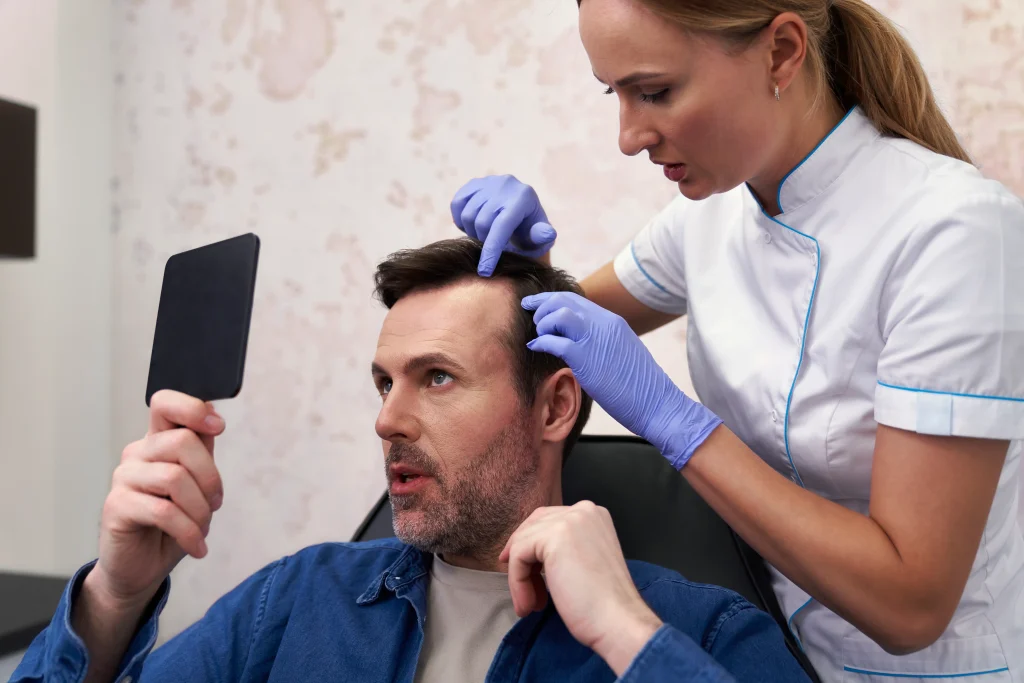
Hair restoration technology has moved quickly, from surgical techniques that left obvious scarring to DNA-matched treatment programs built around individual biology.
The challenge is separating what’s actually available from what’s still in research stages.
Let’s talk about the real state of the field: what’s new in hair transplant surgery, how personalized medicine is changing non-surgical treatment, what the latest research on stem cells actually means, and how to think about all of it when you’re deciding what to do next.
How Hair Restoration Has Changed and Why Now Is Different
For most of its history, hair restoration meant surgery or nothing. The field of hair restoration was defined for decades by hair transplant procedures that moved follicular units from donor areas to areas of baldness or thinning hair. That’s still one of the most effective options available, but the approach to both surgical and non-surgical treatment has changed considerably.
Early hair transplant surgery moved large “plugs” of scalp tissue that often looked unnatural. The shift to follicular unit transplant (FUT) and then follicular unit excision (FUE) brought significantly more natural results. The advancements in hair restoration techniques that matter today aren’t a single breakthrough; they’re a set of tools that work better when used together and matched to the individual.
What’s new now is the integration of genetic science, personalized medicine, and improved surgical technology. Someone experiencing hair loss today has access to a much wider range of hair restoration options than they would have had a decade ago.
Latest Hair Transplant Technology: FUE, Robotic Systems, and What's Changed
Hair transplant surgery has become more precise, less invasive, and more predictable. The latest innovations in surgical hair restoration center on technique refinement, technology-assisted harvesting, and what happens after the procedure.
FUE and FUT: Still the Foundation
Follicular unit transplant (FUT) and FUE remain the two primary hair transplant technique options. FUT removes a strip of scalp from the donor area, allowing for high-volume graft harvesting in a single session. FUE excises individual hair follicles one at a time, leaving no linear scar. Both produce natural-looking results in the right hands. The choice depends on the patient’s hair loss patterns, available donor hair, and goals.
According to the International Society of Hair Restoration Surgery, FUE now accounts for the majority of hair transplant procedures performed worldwide.
Robotic-Assisted Hair Transplantation
Robotic systems use computer vision and AI to identify and excise healthy hair follicles with precision, reducing follicle damage, and improving graft survival rates. The technology maps scalp density and selects follicles based on health and positioning, reducing human error in a step that significantly affects final results. It’s a meaningful step forward in new hair transplant precision, though it works best for patients with certain hair types and loss patterns.
Supporting Existing Hair After Surgery
A hair transplant doesn’t stop future hair loss in non-transplanted areas. Most providers now pair surgical hair restoration with ongoing treatment–typically minoxidil3, finasteride, or a personalized compounded medication to slow hair loss and support existing hair over time. This combination approach produces better long-term outcomes than surgery alone.
| Technique | Best For | Key Advantage |
|---|---|---|
| FUE | Most hair types; patients avoiding visible scars | No linear scar; faster recovery |
| FUT | High-volume graft needs in one session | Larger yield per session; lower per-graft cost |
| Robotic-assisted FUE | Precision harvesting; consistent follicle selection | AI-guided extraction; reduced follicle damage |
| Combination with medical tx | Protecting non-transplanted hair after surgery | Improves long-term outcomes and existing hair health |
DNA-Driven Treatment: How HairClub RX Personalizes Hair Restoration
One of the most meaningful improvements in hair restoration over the past few years has been the shift toward personalized medicine. Rather than applying a standard hair loss treatment to everyone experiencing hair loss, programs now use genetic data to match treatment to individual biology.
HairClub RX is a practical example of this approach. It starts with a buccal (cheek) swab DNA6 test that analyzes your genetic profile to determine which active ingredients are most likely to produce real results for your specific hair loss conditions and biology. A licensed telehealth9 provider reviews those DNA results alongside your medical history and prescribes a custom compounded medication.
That prescription may include up to 12 active ingredients, including clinically used options like minoxidil, finasteride, dutasteride, spironolactone, and others, matched to you specifically, not to an average response profile.
The program doesn’t stop at the prescription. It includes daily supplements, sulfate-free hair care products, in-center hair therapy sessions with a certified specialist, and quarterly progress tracking using high-magnification scalp analysis to track density and follicle health. For some clients, an optional laser cap using low-level laser therapy7, 8 is incorporated based on individual progress.
This kind of personalization is why HairClub RX represents a genuine step forward in how non-surgical hair restoration can work. Hair loss patterns, genetic hair loss sensitivity, hormonal factors, and scalp conditions all vary between individuals. A program that accounts for those differences, rather than applying the same topical to everyone, is closer to how regenerative medicine is approaching chronic conditions more broadly.
PRP and Growth Factor Therapy: Supporting Hair Regrowth with Your Own Biology
Platelet-rich plasma (PRP) therapy has become a standard part of many hair restoration protocols. The process draws a small blood sample, concentrates the growth factor-rich plasma through centrifugation, and injects it into the scalp. The growth factor content in platelet-rich plasma helps stimulate hair growth by improving blood supply to hair follicles and encouraging follicle cell activity.
Results take time; most people need multiple sessions over several months before seeing meaningful changes in hair density and thickness. But PRP is now considered a legitimate tool for the right candidate, both as standalone hair therapy and as a complement to surgical or medical treatment.
PRP is used to support graft survival after hair transplant surgery, to stimulate hair follicles in areas where thinning is progressing, and to help restore hair growth in patients who want non-surgical support alongside medical treatment. It’s not a replacement for a comprehensive treatment plan, but it fills a real gap between topical treatments and surgical options.
Stem Cell Research and the Future of Hair Restoration: What the Science Actually Says
Stem cell research represents the most genuinely exciting area in the future of hair loss treatment and also one that requires the most measured expectations. The core concept: hair follicle stem cells drive the hair growth cycle. If researchers can reliably activate dormant hair follicles or grow new healthy hair follicles from stem cells, it could change how we approach hair loss entirely.
A 2021 study from UC Irvine published in Nature Cell Biology identified a lipid metabolic pathway that activates hair follicle stem cells, a finding with potential implications for treating genetic hair loss and alopecia.
The honest picture on stem cell hair treatment: most of this research is still in early or preclinical stages. Hair cloning and regenerating new follicles through stem cells are not widely available as proven clinical treatments. Some commercial treatments today market “hair regenerative” or “stem cell” benefits, but the regulatory and evidence landscape for these claims is uneven. Approach them with care.
What’s meaningful right now is that the science behind how hair follicle cells work is advancing at a real pace. That research is influencing ingredient development, treatment timing, and how providers understand what activates or inhibits follicle activity, even within non-surgical programs available today.
Non-Surgical Hair Restoration: What's Available and What Actually Works
- Topical and oral minoxidil: FDA-cleared for male and female hair loss. Extends the hair growth cycle and improves blood supply to hair follicles. One of the most studied tools available to stimulate hair follicles and slow hair loss.
- Prescription DHT blockers (finasteride, dutasteride): Reduce the hormone that causes follicle miniaturization in pattern hair loss. Frequently incorporated into personalized compounded prescriptions alongside other ingredients.
- Low-level laser therapy (LLLT): FDA-cleared for hair loss. Uses laser light to support follicle activity and blood supply. Often recommended as part of combination protocols.
- PRP therapy: Concentrated growth factors from your own blood injected into the scalp to support follicle health and hair density. The evidence base is growing.
- Hair systems: For people who want immediate coverage while pursuing regrowth treatment, a custom non-surgical hair system provides full, natural-looking coverage without surgery.
The key shift is integration. Combining treatments that address different aspects of hair loss, matched to the individual’s biology, hair loss type, and goals, consistently outperforms any single tool used alone. That’s why the best hair restoration programs today are built around personalization rather than off-the-shelf formulas.
What's New in the Next Few Years
The future of hair restoration will likely be shaped by three trends: genetic testing becoming standard in treatment selection, stem cell-derived therapies reaching clinical trials, and combination protocols becoming more precisely tailored to individual response.
The improvements in hair restoration happening now aren’t about a single innovation. They’re about better personalization, more effective combinations, and a clearer understanding of how individual biology shapes what works. That shift is already visible in programs like HairClub RX, and it’s accelerating.
Frequently Asked Questions
What is the latest technology in hair restoration?
Current hair restoration technology includes robotic-assisted FUE surgery, DNA-personalized compounded treatments, PRP therapy using platelet-rich plasma and growth factors, and low-level laser therapy. Stem cell hair research is producing genuine advances, though most clinical applications for regenerating new follicles are still in development.
Is stem cell hair restoration available now?
Stem cell hair restoration is an active research area. Some treatments marketed today claim stem cell-derived benefits, but truly regenerative stem cell hair therapy, growing new hair follicles from stem cells, is not yet widely available as a proven clinical option. Research is advancing, and clinical trials are underway. For now, available treatments focus on supporting existing follicles rather than regenerating new ones.
How is HairClub RX different from standard hair loss treatments?
HairClub RX uses a DNA test to identify which active ingredients are most likely to work for your specific biology, then builds a custom compounded prescription around those results. A licensed provider prescribes the medication, and your progress is monitored quarterly. It also includes supplements, hair care products, in-center hair therapy, and specialist support, a much more personalized and monitored approach than a standard online hair loss treatment.
What does PRP do for hair loss?
FUE (Follicular Unit Excision) removes individual hair follicles from the donor area without a linear scar and offers a faster recovery. FUT (Follicular Unit Transplant) removes a strip of scalp to harvest often a larger volume of grafts in a single session, useful when a high number of grafts is needed. Both techniques produce natural results; the right choice depends on the individual’s hair loss pattern, donor availability, and goals.
What is the difference between FUE and FUT for hair transplantation?
For most people, no. Rosemary oil works best as a supportive element alongside other treatments rather than as a replacement for prescription hair loss options. Finasteride and minoxidil work through well-established mechanisms that rosemary oil may not fully replicate, especially for moderate or progressing androgenetic alopecia. A hair loss specialist can help determine where rosemary oil fits within a plan that addresses the actual cause and stage of your loss.
Does combining treatments produce better results?
In most cases, yes. Hair loss involves multiple factors — genetics, hormones, scalp health, and more. Combining treatments that address different aspects of the problem tends to produce better outcomes than any single approach. Programs like HairClub RX are designed around this principle: a compounded prescription, premium hair care products, nutritional supplements, in-center therapy, and progress tracking all working together for a specific individual.
Taking the Next Step in Hair Restoration
Hair restoration has never offered more options than it does right now. More precise surgical techniques, DNA-matched treatment programs, and a growing understanding of how follicle biology works means that more people have realistic paths forward than they did five years ago.
Whether you’re curious about surgical options, want to understand what a personalized non-surgical program could look like for your situation, or just want a clear picture of where the science actually stands, a conversation with a specialist is the most useful starting point.
See what’s possible for your hair loss: no pressure, no guesswork.
HairClub offers complimentary consultations at 100+ centers across North America. A Certified Hair Loss Specialist will evaluate your hair and scalp and walk you through solutions matched to your stage of hair loss and goals, including personalized programs like HairClub RX.
There’s no obligation, just a realistic picture of your options.
©2026 HairClub. All rights reserved. Results may vary.