
Biotin helps hair grow in one situation: when low biotin is the reason it stopped. Correcting the deficiency may reduce the associated shedding over time. For everyone else, which is most people taking a biotin supplement, controlled research has not shown that extra biotin makes hair grow faster, thicker, or back.
That is the answer dermatology sources agree with unusual consistency, and this article does not argue with it. What it adds is the part they leave out: how to tell whether biotin is actually your problem, and what to do when the shedding continues and it clearly is not. HairClub has spent 50 years on that question with clients at more than 100 locations, so the guidance here is built to get you to a real answer rather than to another bottle.
Quick reference: biotin and hair growth
Does it work? Yes, it may help, when low biotin is the cause. No strong evidence otherwise.
Who it may help: People with a deficiency: pregnancy, heavy alcohol use, gut or bariatric conditions, certain medications, a rare inherited disorder.
How much: Adults need about 30 mcg a day. Hair supplements contain 2,500 to 10,000 mcg. The deficiency study used 5,000 mcg for three months.
How long: Three to six months before judging, and only if a deficiency existed.
Main caution: Supplement-level doses can distort thyroid and cardiac blood tests. Tell your doctor before any bloodwork.
What it cannot fix: Pattern thinning driven by DHT, low iron, thyroid problems, or stress shedding.
Does Biotin Help Hair Growth? The Short Answer
Biotin is an essential vitamin, and hair does need it. Dermatology sources agree with unusual consistency on what happens when you add more: biotin supplementation can help in people with low biotin levels, and there is no good evidence that it does anything to improve hair in people whose levels are already normal.
It helps to separate three things people mean by “hair growth”. Growing existing hair faster is the least likely benefit; the vitamin does not shorten the growth cycle or increase hair density on its own. Reducing breakage in existing strands is plausible in people who are low in biotin, because keratin quality depends partly on it. Regrowing hair that has already been lost is the hardest case, and biotin for hair regrowth only makes sense when a lack of biotin caused the loss in the first place.
If a friend swears by it, two explanations cover most cases. They may have had undiagnosed low levels of biotin, in which case biotin really did help. Or they took a hair, skin and nails formula that also contained iron, zinc or vitamin D, corrected a different shortfall, and credited the label. Either way, their improvement in hair says little about yours.
How Biotin Works in the Hair Follicle
Biotin, also called vitamin B7 or vitamin H, is a water-soluble B vitamin. Its job is to assist a family of enzymes called carboxylases, which the body uses to turn food into energy and to build fatty acids and break down amino acids. Keratin, the protein that makes up most of each strand, depends on that machinery. That is why biotin plays an important role in healthy hair and nail growth, and why thinning hair, brittle nails, and a scaly rash are often among the first signs of a shortage.
The supplement category rests on a small logical slip: treating “necessary” as if it meant “limiting”. Supplemental biotin has not been shown to improve hair growth in people without deficiency. Biotin is water-soluble, so whatever the body cannot use leaves in urine within hours, but high supplemental intake can cause clinically significant false laboratory results.
What the Research Actually Shows About Biotin and Hair Growth
Given the widespread popularity of biotin as a hair supplement, the research base is small, and most of it points the same way. The table shows the studies dermatology sources cite most, with a plain reading of what each means for you.
| Study | What was studied | What it found | What it means for you |
|---|---|---|---|
| Patel et al., 2017, Skin Appendage Disorders | Systematic review of published case reports and trials of oral biotin for hair or nail growth | 18 cases of improvement, every one with an underlying cause: inherited enzyme deficiency (10 cases), a restrictive diet, a medication, or uncombable hair syndrome. Nothing in healthy people. | With no deficiency, this review found nothing to suggest a supplement will help. |
| Trueb, 2016, International Journal of Trichology | Serum biotin measured in 541 women complaining of hair loss | 38 percent had low levels; only 11 percent of those had a known risk factor. | Low levels are more common than assumed in women who are shedding. A reason to test, not proof of a treatment. |
| Ablon, 2012, Dermatology Research and Practice | A Double-blind, Placebo-controlled Study Evaluating the Efficacy of an Oral Supplement in Women with Self-perceived Thinning Hair | The supplement group reported better volume and coverage than placebo. | The product contained zinc, iron, and other actives. Any benefit cannot be attributed to biotin alone. |
| Journal of Clinical and Aesthetic Dermatology review, 2024 | Literature search for controlled studies of oral biotin for hair growth or quality | Three studies met criteria. The only double-blind placebo-controlled trial found no difference from placebo. | The authors describe a large gap between public perception and what the literature supports. |
Two things stand out. Every documented case in which biotin clearly helped had an underlying cause, from inherited enzyme problems to the cases of uncombable hair syndrome in children. And the trials that marketing leans on tested multi-ingredient products, so the improvement of hair growth in those studies cannot be credited to one ingredient. The 2016 finding that 38 percent of shedding women had low serum biotin is worth knowing, but it shows deficiency is more common in that group than assumed, not that biotin is a hair loss treatment.
A summary of biotin’s efficacy is this: it corrects a biotin problem, and it hasn’t been shown to correct any other kind of hair problem.
Who Biotin Is Likely to Help: Biotin Deficiencies and Risk Factors
True deficiency is uncommon in people eating a varied diet, because biotin is found in many foods and gut bacteria produce some as well. It is not zero, though, and the causes of biotin deficiency cluster in situations you can check against your own.
| Situation | Why it lowers biotin |
|---|---|
| Pregnancy and breastfeeding | At least a third of pregnant women develop marginal biotin deficiency in spite of normal biotin intakes. |
| Heavy or long-term alcohol use | Alcohol reduces absorption in the gut. |
| Inflammatory bowel disease, gastric sleeve or bypass surgery | Less absorbing surface and less biotin from gut bacteria. Shedding after bariatric surgery is well documented. |
| Long-term antiepileptic medication (carbamazepine, phenytoin, phenobarbital) | These drugs increase biotin breakdown and lower blood levels over time. |
| Isotretinoin for acne | Associated with lower levels during treatment. |
| A diet heavy in raw egg whites | Raw egg white contains avidin, a protein that binds biotin and blocks absorption. Cooking destroys avidin. |
| Biotinidase deficiency | A rare inherited condition in which the body cannot recycle biotin. Usually identified at newborn screening. |
Signs that tend to travel with deficiency-driven hair fall:
- A red, scaly rash around the nose, mouth, or eyes
- Brittle nails that split or peel, since poor hair and nail growth often appear together
- Unusual fatigue, or tingling in the hands or feet
When Biotin Will Not Help: Pattern Hair Loss and Other Causes
The most common cause of thinning in both men and women is androgenetic alopecia, or pattern hair loss. In people who carry the sensitivity, follicles on the top and front of the scalp respond to a hormone called DHT by shrinking a little with each growth cycle, producing finer and shorter hairs until some follicles stop producing visible hair at all. That is a signaling problem between a hormone and a receptor. Biotin does not act on DHT, so it cannot prevent this kind of hair loss at any dose.
Several other frequent causes are also outside its reach. Low iron is a different nutrient and one of the most common reasons for shedding in women. Thyroid disorders shift the growth cycle. Telogen effluvium, the heavy shedding after illness, surgery, rapid weight loss, or major stress, usually resolves on its own timeline. Postpartum shedding is hormonal; traction from tight styles is mechanical. More biotin is not the answer to any of these.
The cost of guessing wrong is time. People commonly cycle through supplements, shampoos, and serums for a year or more while pattern loss continues, and follicles that have been shrinking for years are harder to help than those caught early. Once the cause is known, HairClub’s guide to regrowing thinning hair covers the hair treatments that apply.
How Much Biotin Should You Take for Hair Growth?
The confusion here comes from two different numbers being presented as the same thing.
The first is what your body needs. There is not enough data for the usual Recommended Daily Allowance (RDA), so the National Academies set a daily adequate intake instead: 30 micrograms (mcg) for adults and 35 mcg when breastfeeding. Typical US diets are estimated to deliver 35 to 70 mcg a day, so most people get enough biotin without trying.
The second is what supplements contain. Biotin pills for hair growth commonly carry 2,500 to 10,000 mcg, roughly 80 to 330 times the adequate intake. In the deficiency literature, women with confirmed low levels were treated with 5,000 mcg (5 mg) a day, typically for about three months. That is a treatment dose for a diagnosed problem, not a recommended biotin intake for normal levels.
No tolerable upper limit has been set, because toxicity has not been observed. But “not harmful” is not “helpful”, and the high doses of biotin in hair products are in the range of biotin that interferes with certain lab tests, covered below. If you are going to take biotin, a doctor can set the dose against your blood level rather than the label.
On timing: scalp hair grows about a centimeter a month, and each strand spends years in its growth phase. Three to six months of daily biotin is the minimum before judging any change, and only if a deficiency existed. If your levels were normal, more months will not produce a different result.
Biotin Pills, Shampoo or Food: Does the Form Matter?
Oral biotin. Supplements are the only form with evidence, and only for deficiency. Gummies, capsules, and tablets deliver the same vitamin; the type of biotin product matters far less than whether you needed it.
Biotin shampoo and conditioner. A shampoo is rinsed away in about ninety seconds, so the amount reaching the follicle is negligible. These products can improve how hair feels and behaves, a legitimate hair care benefit, but they do not change growth.
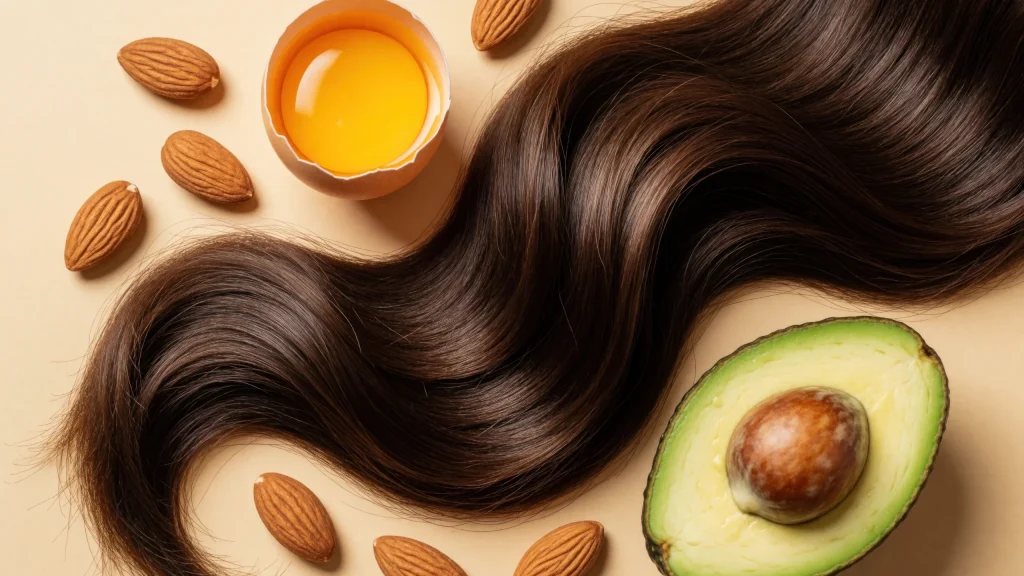
Food. Cooked eggs, liver, salmon, sunflower seeds, sweet potato, and almonds all contribute, and an ordinary diet covers the adequate intake. Raw egg whites are the one thing to avoid in quantity, for the avidin reason above.
Side Effects of Biotin and the Lab Test Problem
At normal and even high intake, biotin has a good safety record. Reported side effects of biotin are uncommon and mild: digestive upset, acne flares in some people, and at very high intake, thirst and more frequent urination.
The issue that matters is different. Many blood tests use biotin in their chemistry, and supplement-level amounts in the blood can push results falsely high or low. The US Food and Drug Administration issued a safety communication on this in 2017 and updated it in November 2019 after continuing reports of harm. Its particular concern is a falsely low troponin result on some assays, which can mask a heart attack. In everyday practice, thyroid function tests are the ones most often affected; a person taking the supplement can appear to have an overactive thyroid when they do not.
Two practical rules follow. Tell every clinician you see that you take biotin, including any prenatal or multivitamin that contains it. And ask before bloodwork whether to pause; Cleveland Clinic recommends stopping three days before thyroid labs. Two smaller notes: long-term antiepileptic medication lowers biotin levels, and people with diabetes should discuss biotin use with their doctor, since biotin supplements may affect fasting glucose readings.
How to Find Out Whether Biotin Is Your Problem (and What to Do If It Is Not)
There is a straightforward order of operations, and it does not start with buying anything.
- Get the right blood panel. If the self-check above flagged you, ask your doctor for a panel that includes plasma biotin alongside ferritin. Those are the vitamins, minerals, and hormonal factors that actually show up in people with hair loss, and testing them together avoids fixing one and missing another. No single measure of biotin is perfect, which is another reason to read it alongside the rest. Remember the pause before the draw.
- If your levels are normal and the thinning is continuing, the cause is likely not something a vitamin can reach. The useful question then changes from “which supplement” to “which kind of hair loss”, and that needs someone to look at your scalp rather than at a label.
This is where HairClub starts. Every consultation begins with an in-person hair and scalp analysis that sets a baseline for hair density, follicle condition, and scalp appearance, so treatment can be measured against something real. For the right candidate, HairClub RX builds on that baseline with a DNA-based test, taken by cheek swab at a participating US location, which may help indicate which prescription actives a person is more likely to respond to, among them minoxidil, finasteride, dutasteride, and spironolactone. A licensed telehealth provider reviews your history and the lab’s recommendation and, if appropriate, prescribes a compounded medication.
Biotin still has a place in that plan. The HairClub RX dietary supplements include biotin and horsetail as supporting ingredients alongside the prescription actives chosen to help address the underlying cause. That is the proportion it deserves: one part of a program built around what is actually happening at the follicle, rather than the whole strategy.
The HairClub RX DNA test was developed and its performance characteristics determined by GX Sciences. It has not been cleared or approved by the FDA. Compounded medications are not FDA-approved as combinations, and the FDA does not evaluate their safety or effectiveness. HairClub RX is available at participating US locations only. Results vary.
Frequently Asked Questions
Does biotin help hair growth?
Only when low biotin is the reason for shedding. In people with normal levels, controlled research has not shown a benefit. It may strengthen existing strands in someone who was deficient, but it does not regrow hair lost to pattern thinning.
How much biotin should I take daily for hair growth?
Adults need about 30 mcg a day, and most diets already provide it. Supplements usually contain 2,500 to 10,000 mcg, and the deficiency study used 5,000 mcg a day for three months. Ask a doctor to set a dose against a blood test rather than the label.
How long does biotin take to work for hair?
Scalp hair grows about a centimeter a month, so allow three to six months before judging any supplement. If you were not deficient to begin with, more time will not change the result.
Is 10,000 mcg of biotin too much?
No upper limit has been set, and toxicity has not been observed, but doses that high are the ones most likely to distort thyroid and cardiac blood tests. Tell your doctor you take it and ask whether to pause before any bloodwork.
Can biotin cause hair loss?
There is no evidence that it causes hair loss, and stopping a supplement does not trigger shedding. Shedding that continues while taking it points to a cause the vitamin does not address, such as pattern thinning, low iron, or a thyroid issue.
Does biotin help hair regrowth after hair loss?
It may, if a deficiency caused the loss. For pattern thinning, which comes from follicle sensitivity to DHT, it does not address the cause. Prescription actives and in-center treatments are the relevant options, and a hair and scalp analysis is the way to find out which apply to you.
Is biotin better as a pill, a shampoo or from food?
Oral biotin is the only form with evidence, and only for deficiency. Shampoos are rinsed off too quickly to deliver a meaningful amount to the follicle. An ordinary diet already covers the adequate intake, so extra biotin from any source rarely changes anything.
Stop Guessing About Your Hair Loss
Biotin may be worth taking, with a doctor’s guidance, when a blood test says you are low in it, and worth skipping as a strategy when it says you are not. Either way, the next step is finding out what your hair is actually doing. A free, no-obligation consultation at a HairClub center starts with a hair and scalp analysis, and if HairClub RX is a fit, biotin will be one part of a plan built around the underlying hair loss rather than a guess at it.