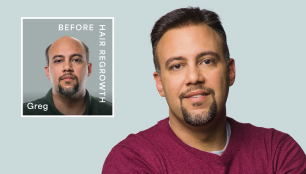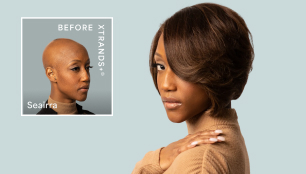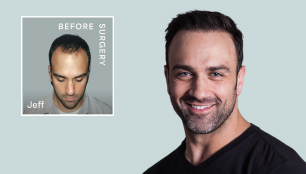

In clinical trials, finasteride regrew hair in some men, held hair loss steady in a larger group, and failed to stop further loss in a minority. It acts on hormonally driven pattern loss only; it takes months rather than weeks, and the benefit lasts only while treatment continues. Response varies enough that measuring it matters more than predicting it.
QUICK REFERENCE
- What it is: An oral prescription medication, sold as Propecia at the 1 mg strength, that blocks the enzyme converting testosterone into DHT.
- Who it is approved for: Men only, for male pattern hair loss. Not indicated for women or children. Its effect on recession at the temples has not been established.
- What the trials used: One 1 mg tablet daily. Dosing is a decision for a prescriber, not a reader.
- When change shows: Three months or more of daily use before benefit is generally observed, with a fuller picture at twelve months.
- Three things to raise with a prescriber: possible side effects including sexual and mood changes, the pregnancy contraindication, and the effect on the blood test used to check for prostate cancer.

What finasteride is and how it acts on the follicle
Pattern hair loss, known clinically as androgenetic alopecia, is driven by dihydrotestosterone, or DHT. The body makes DHT from testosterone using an enzyme called 5-alpha reductase, which exists in two forms. Type II is the form found in hair follicles and the prostate, and it accounts for roughly two-thirds of circulating DHT.
A balding scalp contains higher levels of the enzyme 5-alpha-reductase which produces a higher local scalp level of DHT. It also has more follicles with a higher density of receptors that bind the DHT than other scalp areas that are not balding. Over successive cycles, those follicles produce finer, shorter hairs until they stop producing visible hair at all. Scalp hair is unusual in this respect: DHT thins it, while the same hormone drives beard and body hair.
Finasteride blocks that conversion by competitively inhibiting the Type II enzyme, with around a hundredfold selectivity for Type II over Type I, which lowers DHT levels in both blood and scalp tissue. The FDA label reports serum DHT suppression of about 65 percent within 24 hours of a single 1 mg dose, with circulating testosterone rising by roughly 15 percent and staying within the normal physiological range.
One point of confusion worth clearing up: the same molecule is sold at 5 mg as Proscar, for benign prostatic enlargement. That is a separate indication at a separate dose, and all the hair loss evidence below comes from the 1 mg studies.
APPROVAL AND OFF-LABEL STATUS
- The 1 mg formulation is indicated for male pattern hair loss in men only.
- It is not indicated for women or children.
- The label states that efficacy in bitemporal recession, meaning the corners of the hairline at the temples, has not been established.
- Topical finasteride is compounded rather than FDA-approved. Compounded preparations are not evaluated by the FDA for safety, effectiveness or quality.
What the evidence actually shows
The registration program ran three double-blind, randomized, placebo-controlled trials over twelve months, enrolling 1,879 men aged 18 to 41 with mild to moderate loss. Two enrolled men with vertex, or crown, loss and accounted for 1,553 of them; a third enrolled 326 men with loss in the anterior mid-scalp. Extensions carried a subset out to five years.
Scalp hair counts were taken from photographic enlargements of a one-inch circle. At twelve months there was a 107-hair difference between treated and placebo groups, rising to 138 hairs at two years and 277 at five. Part of that widening reflects continued gains and part reflects the placebo group declining faster, which is worth holding in mind when reading any long-term figure. A separate 48-week study in 212 men found the proportion of hairs in the active growth phase rising from 62 to 68 percent.
Improvement, stabilization and continued loss are three different outcomes
An independent panel rated standardized photographs without knowing who had received what. At twelve months, 48 percent of treated men showed an increase in hair against 7 percent on placebo. At five years the treated group split three ways: 48 percent improved, 42 percent unchanged with no further visible progression, and 10 percent worse than baseline. In the placebo group the same three figures were 6, 19, and 75 percent.
Read that middle number carefully. Improvement was the single largest outcome at five years, 48 percent, but close behind it, at 42 percent, was a group whose hair loss simply stopped getting worse. Against a progressive condition, holding a position is a real outcome rather than a consolation, and treating it as failure is the most common reason people abandon treatment that is working.
A realistic timeline for hair growth
The label is explicit that daily use for three months or more is generally necessary before benefit is observed. Trial assessors did detect differences as early as three months, but from standardized photographs rather than everyday observation.
- Months 0 to 3. DHT levels fall within a day of the first dose, but hair responds far more slowly than hormones do. Visible change is unlikely here, and its absence says nothing about whether treatment will work.
- Months 3 to 6. The earliest point at which change becomes detectable, usually as loss slowing rather than as new hair appearing.
- Months 6 to 12. The window in which the trials recorded their twelve-month endpoints. If a response is going to be visible, this is generally where it becomes so.
- Beyond 12 months. Assessment shifts from whether it is working to whether it is holding.
Early shedding
An increase in shedding during the first weeks or months is described often by patients and clinicians, and this is biologically consistent with follicles being pushed out of a resting phase into a new growth cycle, which requires the old hair to be released first.
It should be said plainly that this was not an endpoint captured in the pivotal trials, so the evidence is clinical observation rather than trial data, and its frequency is not well characterized. Shedding that is heavy, prolonged, or accompanied by scalp symptoms warrants contacting a prescriber rather than waiting it out.
The plateau after year two
Among men who use finasteride long term, maximum improvement in hair count compared with baseline was reached during the first two years. After that, the treated group showed a slow decline, though counts stayed above baseline throughout five years of follow-up.
Knowing this in advance matters. A man at year three who is no longer gaining ground may conclude the medication has stopped working. The data suggests a slow drift down from a peak is the expected trajectory rather than a failure, and that the gap against no treatment keeps widening even as the absolute count eases off.
Who it may suit, and who it may not
The trials enrolled men with mild to moderate loss, specifically not complete loss. That is the clearest candidacy signal in the dataset. Where a follicle has stopped producing hair altogether, lowering DHT gives it nothing to work with. Where follicles still produce hair, only thinner each cycle, there is something to preserve.
Region matters too, and this is where marketing and label diverge. The vertex and anterior mid-scalp trials both showed significant hair count increases. The label states separately that efficacy in bitemporal recession has not been established, and mid-scalp hair counts deliberately excluded both that area and the anterior hairline itself.
So for a man whose main concern is the corners of his hairline receding, the honest position is that the evidence supporting the crown and mid-scalp does not extend to that region. That does not mean it cannot help. It means it has not been shown to, which is a different and more useful statement.
It also addresses one mechanism only. Hair loss driven by illness, nutritional deficiency, thyroid disease, medication, or scarring conditions of the scalp does not respond to a DHT blocker, and starting one before establishing the cause can waste a year.
This is also where a one-size-fits-all prescription runs into its limits. HairClub RX begins with a baseline hair and scalp analysis and a DNA test, which can help identify which active ingredients a given person is more or less likely to respond to before a formulation is chosen, rather than after months of trial and error.
Topical finasteride
Topical finasteride is applied to the scalp rather than swallowed, to reduce DHT where it matters while limiting how much reaches the rest of the body. In the United States, it is available only as a compounded preparation, which means it has not been evaluated by the FDA for safety, effectiveness, or quality.
The strongest evidence is a phase III randomized, double-blind trial published in the Journal of the European Academy of Dermatology and Venereology in 2022, which randomized 458 men across 45 European sites to a 0.25 percent spray, oral finasteride, or placebo for 24 weeks. Hair count improved significantly against placebo and comparably to the oral arm, while serum DHT fell less than it did on finasteride tablets. That difference is the mechanistic basis for expecting fewer systemic effects.
The limitations deserve equal billing. Twenty-four weeks is short for a treatment taken indefinitely, only 323 of the 458 men randomized completed, and there is no long-term safety record comparable to the multi-year dataset behind the oral formulation. Lower systemic exposure is a reasonable expectation rather than a demonstrated safety advantage, and the pregnancy precautions below apply here too, since a treated scalp can transfer product by contact.
Where a compounded formulation is appropriate, that oversight matters. HairClub RX compounded medications are formulated and monitored by licensed telehealth providers, with dosing adjusted based on measured progress rather than fixed at the outset.
Finasteride and women
Any use in women is off-label, and the safety considerations are more serious than for men.
The pregnancy contraindication is absolute. Because the medication blocks a conversion required for normal development of male genitalia, it can cause birth defects in a male fetus. It is contraindicated in women who are pregnant or who may become pregnant. Women in that group should not handle crushed or broken tablets, since the coating is what prevents skin contact with the active ingredient. Where contact does occur, the label directs that the area be washed immediately with soap and water.
On whether it works, the label contains one controlled trial: 137 postmenopausal women with pattern hair loss, 67 on treatment and 70 on placebo, over twelve months. Effectiveness could not be demonstrated. There was no improvement in hair counts, in the women’s own assessments, in investigator assessments, or in ratings of standardized photographs.
Smaller studies at higher doses have reported mixed findings, but the evidence base in women remains limited and nothing like the record that exists in men. Women with thinning hair have better-evidenced options to consider with a clinician, and pattern loss in women more often has contributing causes worth investigating first.
Side effects, risks and monitoring
In the three twelve-month trials, reported side effects considered drug-related occurred at low rates. The placebo comparison is the part that makes them interpretable.
| REPORTED IN YEAR ONE | FINASTERIDE 1 MG (N=945) | PLACEBO (N=934) |
|---|---|---|
| Decreased libido | 1.8% | 1.3% |
| Erectile dysfunction | 1.3% | 0.7% |
| Any of the above | 3.8% | 2.1% |
| Stopped treatment because of these effects | 1.2% | 0.9% |
The incidence of each fell to 0.3 percent or below by the fifth year, and among men who stopped because of them the effects resolved, as they did in most of those who continued. Overall discontinuation for drug-related reasons was 1.4 percent on treatment against 1.6 percent on placebo. Breast tenderness, enlargement and testicular pain occurred at rates no different from placebo, though changes in breast tissue should be reported promptly to a doctor. Non-scalp body hair was not affected.
Persistent effects and mood
Post-marketing surveillance has recorded reports of sexual side effects continuing after treatment stopped, including erectile, libido, ejaculation and orgasm disorders, along with depression and suicidal ideation and behavior. These appear in the label under postmarketing experience.
That category carries a specific meaning. Reports are submitted voluntarily from a population of unknown size, so their frequency cannot be reliably estimated, and causation cannot be established from them. That is a real limitation, and it is also not a reason to dismiss them. Anyone weighing this medication is entitled to hear both. Mood changes during treatment are worth raising with a prescriber promptly.
PSA testing and prostate cancer screening
This is the consequence most pages leave out, and it has a long tail.
The medication lowers PSA, the blood test marker used in prostate cancer screening. In the 1 mg studies in men aged 18 to 41, mean PSA fell from 0.7 to 0.5 nanograms per milliliter by month 12. A randomized trial published in The Lancet Oncology in 2007, following 355 men aged 40 to 60 on the 1 mg dose, found median PSA reductions of 40 percent in the 40 to 49 age band and 50 percent in the 50 to 60 band after 48 weeks, and concluded that the interpretive adjustment already applied at 5 mg should apply at 1 mg as well.
So a PSA result from a man taking finasteride cannot be read the same way as one from a man who is not. The label goes further: any confirmed increase from the lowest value recorded during treatment may signal prostate cancer and should be evaluated, even when the number still falls inside the normal range for untreated men.
Separately, in a seven-year prevention trial using the 5 mg dose, high-grade prostate cancer was found in 1.8 percent of the treated group against 1.1 percent on placebo. The label notes that the significance of that finding for men taking 1 mg for hair loss is not established.
None of this argues against treatment. It argues for the prescriber and whoever orders the screening both knowing about it, which is a coordination problem rather than a medical one, and not one a prescription arriving in the post solves on its own.
Measuring and documenting progress
Everything above describes what happened to groups of men in trials. None of it says what will happen to any one person, and the only way to know is to measure it. The obstacle is that hair loss is slow, and perception is unreliable. Shedding varies day to day and with the seasons, and looking at your own scalp daily is close to useless for detecting change across twelve months, because the reference point keeps moving.
What makes a response legible:
- A baseline recorded before starting. Without it, there is nothing to compare against at month twelve except recollection.
- Standardised photography. Fixed lighting, camera angle and distance, hair parted the same way and at the same dryness. The trials used exactly this discipline for a reason. Inconsistent photographs generate false reassurance and false alarm in equal measure.
- Density measurement. Densitometry counts hairs and gauges shaft caliber in a defined area. It picks up thickening of existing hairs, which is often the first real sign of response and is invisible in a mirror.
- Fixed review intervals. Comparing month zero to month six to month twelve, rather than to last week.
This is where supervised treatment earns its place. A baseline hair and scalp analysis taken in person, repeated on a schedule by someone using the same equipment and conditions each time, produces a record you can actually read. The HairClub RX programme is built around that pattern of baseline assessment and ongoing measurement, with finasteride as one of several possible ingredients in a personalized formulation rather than a single product handed over on its own.
The HairClub RX programme is built around exactly that pattern: a DNA test and in-center baseline assessment, a personalized formulation built from the result, and ongoing progress monitoring on a fixed schedule, with finasteride as one of several possible ingredients rather than a single product handed over on its own.
How it fits alongside other approaches
Topical minoxidil is the most common companion treatment, and it works on a different mechanism, which is why the two are usually considered together rather than as alternatives. Our guide to minoxidil for hair loss covers how it works in detail.
Where a DHT blocker reduces the hormonal signal driving miniaturization, minoxidil acts on the growth cycle itself and increases vasodilation to improve blood flow/circulation to the follicles. Studies of the combination have generally reported better outcomes than either alone. The comparison people usually want, which of the two is better, has no clean answer, because they are not doing the same job.
Dutasteride comes up as the stronger option. It inhibits both forms of 5-alpha reductase rather than Type II alone, and suppresses DHT more completely. In the United States, it is not FDA-approved for hair loss, so any such use is off-label. That is a conversation for a prescriber rather than a straightforward upgrade.
A HairClub RX formulation can combine several of these ingredients, finasteride, minoxidil, or dutasteride among them, into a single compounded prescription tailored to an individual’s DNA results and treatment response, rather than requiring separate products managed alone.
What happens if you stop
This treatment does not change the underlying tendency toward male pattern baldness. It suppresses a mechanism for as long as it is taken, and the label states directly that withdrawal of treatment leads to reversal of effect within twelve months.
The trials show this happening. Men who took the medication for twelve months and were then switched to placebo had lost their hair count gain by month 24. Men who started on placebo and switched after a year did gain hair, but reached a lower absolute count than those who had started a year earlier, and that gap persisted through follow-up.
Two things follow. Treatment is a continuing commitment rather than a course, and the timing of starting affects the ceiling of what can be held.
Frequently Asked Questions
How long does finasteride take to work?
Does finasteride regrow hair, or only stop hair loss?
Is it normal to shed more hair when starting?
Does it work for a receding hairline?
What happens if I stop taking finasteride?
Can women take finasteride?
Does finasteride affect a PSA test?
Is topical finasteride as effective as the tablet?
Where to go from here
This is one option among several, and whether it fits depends on the pattern of loss, its stage, the cause behind it, and the medical picture around it. What is worth doing first is establishing a baseline, because without one there is no way to read the next twelve months.
Booking a HairClub RX consultation puts that baseline on record: a hair and scalp analysis and DNA test, read by a clinician, before any decision about a formulation is made.