
Latanoprost is a prescription glaucoma medication that is sometimes prescribed off-label, as a compounded topical, for scalp hair loss. The human evidence behind that use is small, but it is real. Across the published trials, roughly 30 to 50 percent of participants saw a measurable increase in hair density over six to eight months. The rest saw little or no change.
That split is the whole story of latanoprost, and it is the part most articles skip past. The useful question is not whether latanoprost can grow hair. It is whether it may do so for you, and how you would know either way.
Latanoprost for Hair Growth: Quick Reference
- What it is: A prostaglandin analog, FDA-approved for glaucoma and ocular hypertension. It is not FDA-approved for hair loss.
- How it may work: Appears to recruit resting follicles into the growth phase and support the conversion of fine vellus hairs into thicker terminal hairs.
- Evidence base: Two small human trials in androgenetic alopecia and several in alopecia areata. Results range from meaningful improvement to no effect at all.
- Realistic response rate: Roughly 30 to 50 percent of studied participants over six to eight months.
- Main safety flags: Scalp irritation, localized skin darkening, and unwanted hair growth where the product spreads. No long-term scalp safety data exists.
- Availability: Prescription-only, and it requires a formulation compounded for scalp use. Glaucoma eye drops are not a scalp treatment.
- Where it usually fits: As a possible addition to an established regimen for the right candidate, rather than as a first-line treatment.
What the Evidence Actually Shows About Latanoprost and Hair Growth
Latanoprost arrived in hair research by accident. Patients using it for glaucoma began reporting that their eyelashes were growing longer, thicker and darker, an effect known as hypertrichosis. That effect is well enough established to appear in the standard clinical monograph on latanoprost.
The observation prompted a 2002 pilot study in stump-tailed macaques, one of the few species besides humans that develops pattern hair loss. At 500 micrograms per milliliter, the animals showed moderate to marked hair regrowth, with 5 to 10 percent of vellus hairs converting to intermediary or terminal hairs. At 50 micrograms per milliliter, growth was minimal. The vehicle group showed no effect at all.
A pilot study in primates is a starting point, not a conclusion. Here is what has been found in people.
The 2012 Androgenetic Alopecia Trial
The most cited human study is a randomized, double-blind, placebo-controlled pilot study led by Blume-Peytavi and published in the Journal of the American Academy of Dermatology in 2012. Sixteen men with mild androgenetic alopecia applied 0.1 percent topical latanoprost to one small zone of the scalp and a placebo to another, daily, for 24 weeks.
At 24 weeks the latanoprost zone showed significantly increased hair density compared with both its own baseline and the placebo zone. Around half the participants showed what investigators classed as a clinical improvement. One detail from that trial is worth understanding, because it says something about the mechanism. The ratio of growing hairs to resting hairs stayed stable while the absolute number of both rose. That pattern suggests latanoprost may recruit additional follicles into the growth phase rather than simply extending the cycles of the hairs already growing.
The limitations were substantial, and the authors stated them plainly. Sixteen participants. Young men only. Mild loss only. And half the group reported skin irritation at that concentration.
The Alopecia Areata Studies
Results in alopecia areata are mixed, and the mixture is the point.
A 2022 randomized, double-blind, placebo-controlled trial applied 0.005 percent latanoprost solution to scalp alopecia areata in 30 participants over 12 weeks. Hair density and regrowth improved, and the authors concluded the treatment was acceptably safe and effective. The detail usually left out of summaries is that both groups also received a topical corticosteroid, and that there was no significant difference between the two groups in the reduction of the affected area or in SALT score, which is the standard severity measure. The finding is more modest than it is often reported to be.
A head-to-head comparison was less flattering. In a 2021 randomized study of 50 patients with localized alopecia areata, 24 percent of the latanoprost group achieved a complete response at 16 weeks against 56 percent on 0.05 percent betamethasone dipropionate lotion. The corticosteroid also worked faster. The authors concluded that latanoprost was less effective, though safer, than the steroid.
For alopecia areata of the eyelashes and eyebrows, several small studies found no benefit over applying nothing. A 2023 systematic review and meta-analysis pooling six randomized trials of topical prostaglandin analogs did find significant improvements in hair length and density against placebo, with no significant difference in adverse events, while stating that the best dose and frequency remain unsettled. Both the null results and the pooled positive result belong in the picture.
What the Research Still Does Not Tell Us
Five gaps are worth knowing before anyone forms a view.
- No scalp trial has run longer than roughly six to eight months. Long-term safety on scalp skin has not been established.
- No large trial exists. The androgenetic alopecia evidence rests on studies of 16 and just over 100 participants.
- The optimal concentration and application volume have not been settled, and the studies that exist used quite different combinations of the two.
- Nothing in the published literature reliably predicts who will respond. The trials report that a portion of participants improved. They do not identify what separated them from the participants who did not.
- Evidence in women is thin. A pilot study of topical latanoprost acid in women with female pattern hair loss or chronic telogen effluvium reported improvements over six months, but it is a preprint that has not completed peer review, so it should be read as preliminary.
That last gap is the one that matters most in practice, and it shapes the rest of this article.
How Latanoprost May Work on The Scalp
Latanoprost is a prostaglandin analog. More precisely, it is a selective agonist at the FP prostanoid receptor, which responds to prostaglandin F2 alpha, a naturally occurring substance the body produces from essential fatty acids. In the eye, stimulating that receptor improves fluid drainage and lowers pressure, which is what makes it useful in glaucoma.
Prostanoid receptors are also present in the hair follicle. When latanoprost is applied topically to the scalp, several effects appear to occur together. Follicles sitting in the resting telogen phase of the hair growth cycle may be prompted into the growing anagen phase.
Fine vellus hairs may mature into thicker terminal hairs, which is the change that actually becomes visible. Local blood flow around the follicle may improve, supporting oxygen and nutrient delivery. There is also evidence that shifting precursor molecules toward prostaglandin F2 alpha production reduces prostaglandin D2 activity, which has been implicated in the balding process.
Several of those mechanisms overlap with how topical minoxidil is thought to work, which is one reason the two medications are often discussed together and sometimes prescribed together. The same receptor pathway is also why bimatoprost, the closely related prostaglandin analog sold as Latisse, holds an FDA approval for eyelash hypotrichosis while neither drug holds one for scalp hair loss.
There is an honest limit to all of this. A mechanism explains why a drug might work. It does not establish that it does, and it says nothing at all about who it will work for.
Who Latanoprost May Suit, and Who it May Not
Latanoprost is not a general hair loss treatment. The evidence points toward some situations and away from others, and the type of hair loss involved changes the answer more than any other single factor.
The strongest signal is in androgenetic alopecia, which is pattern hair loss, and it is where both human trials on the subject were run. In scalp alopecia areata, the evidence is genuinely mixed, and at least one comparison found a corticosteroid clearly outperformed it. For eyelash and eyebrow alopecia areata, the evidence points to no benefit.
Telogen effluvium, the diffuse shedding that follows illness, stress, childbirth, or a nutritional deficit, usually resolves once the underlying cause is addressed, which makes any topical difficult to credit and difficult to justify.
Two practical situations bring latanoprost up most often. The first is a plateau, where someone has used minoxidil consistently for a year or more, and improvement has stalled. The second is tolerance, where an established treatment has caused side effects the person is unwilling to live with. In both cases, latanoprost is being considered as an addition or an alternative within a wider plan, not as a replacement for treatments with far stronger evidence behind them.
It is also relevant to women, which is not true of every option in this category. Latanoprost does not carry the sex-based contraindication that finasteride does, and women have been included in the human research on androgenetic alopecia and telogen effluvium. The evidence in women remains limited, and candidacy is still a clinical decision, but the door is not closed in the way it is with some alternatives.
None of that can be settled from a search result. Pattern loss, alopecia areata, telogen effluvium and traction damage can look similar in a mirror and respond very differently to the same medication. Establishing which one is present is the first thing a clinician does, and it is the step that determines whether latanoprost is worth considering at all.
How Topical Latanoprost is Used Under Medical Supervision
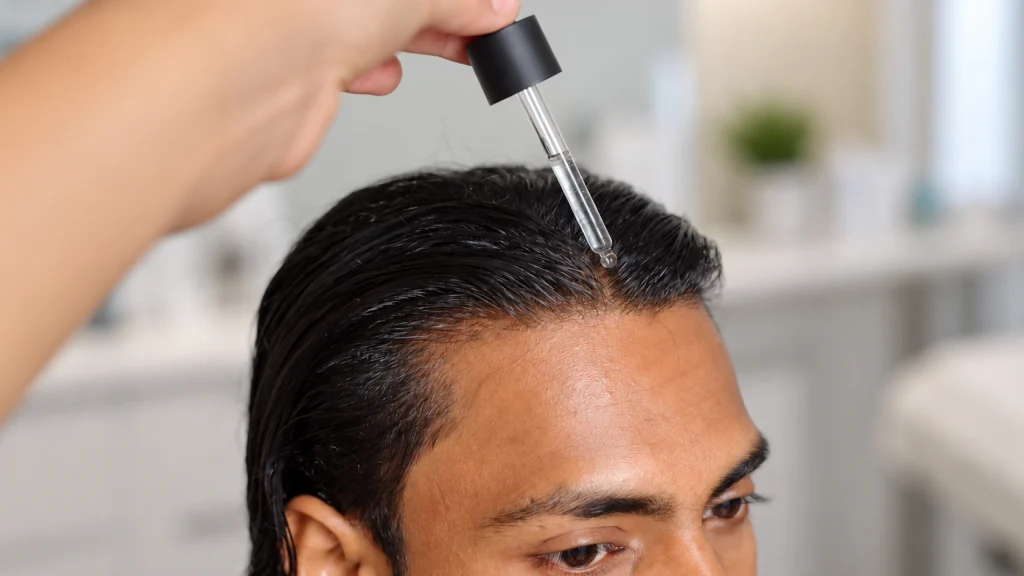
Topical latanoprost for hair loss is a prescription treatment prepared by a compounding pharmacy. There is no over-the-counter version and no standard product, which means the specifics of any regimen are set by the prescribing provider after they have reviewed the case. What follows is what a patient should understand before that conversation, not a protocol to follow independently.
The broad shape of supervised use is consistent across the published research. It is applied to the scalp once daily, to the thinning areas rather than the whole head. Timelines are long, because the studies that measured anything useful ran 24 weeks or more before assessing outcomes. And it is frequently prescribed alongside other actives rather than on its own, since a six-arm comparative study found that 5 percent minoxidil alone and 5 percent minoxidil combined with 0.005 percent latanoprost both improved hair counts, without the combination clearly outperforming minoxidil on its own. Latanoprost at 0.010 percent used alone showed no significant difference from placebo in that study.
Why Concentration and Volume Are Not the Same Thing
This is the single most misunderstood point in the category, and it explains a contradiction that appears across most articles on the subject.
The 2012 trial used a high concentration in a very small volume. The 2018 comparative study used a concentration 10 to 20 times lower, spread across a correspondingly larger volume of solution. Both delivered roughly the same total daily exposure to the drug. The outcomes on tolerance were not the same at all. At the high concentration in a small volume, half the participants reported skin irritation. At the lower concentration spread more widely, adverse events were far less common.
The practical implication is that how a formulation is made matters as much as how strong it sounds. A number on a label describes concentration. It does not describe how much drug reaches the scalp, or how well it will be tolerated once it gets there. That is a compounding and prescribing decision, and it is one of the clearest reasons this is not a treatment to approach alone.
Why Glaucoma Eye Drops Are Not a Scalp Treatment
People do ask this, so it is worth answering precisely rather than simply warning against it.
Some clinical studies have in fact applied ophthalmic latanoprost solution to the scalp, including the 2021 alopecia areata comparison. That is not an argument for doing it yourself. In those studies the concentration, the volume, the area treated, the duration and the monitoring were all controlled by investigators, and participants were screened before they began.
Outside that setting the objection stands. Ophthalmic latanoprost is formulated for the eye, so its volume, preservative system and sterility requirements are built for instillation in single drops rather than distribution across a scalp. A prescription written for your glaucoma is a prescription for your eyes, at a quantity calculated for your eyes. Using it anywhere else means self-selecting a dose for an indication no one has assessed you for. Scalp use calls for a formulation compounded for that purpose and prescribed by a provider who has reviewed the individual case, including any eye conditions and any other medication in use.
Side Effects and Safety Considerations
Most coverage of latanoprost mixes two categories of side effects, and separating them makes the picture much clearer.
The first category is what has been documented when latanoprost is instilled in the eye over long periods. The best known is a permanent darkening of the iris, which typically begins after about a year of daily use and is more common in people with lighter colored eyes. Reported incidence varies widely across studies depending on eye color and treatment duration. This is a finding from eye instillation, and it is not the same as scalp application, but it is the reason the pigmentation question is taken seriously at all.
The second category is what has actually been reported on the scalp. Irritation and dermatitis are the most common, and they were common enough at the higher concentration used in the 2012 trial to affect half the group. Localized skin darkening at the application site has been reported, since latanoprost increases melanin activity. Unwanted hair growth can occur wherever the product migrates, which is why application technique and hand washing matter more here than with most topicals. Latanoprost is, after all, a medication known for making hair grow in places it touches.
The unresolved question sits between the two categories. Because no scalp study has run beyond roughly eight months, and the pigmentation changes seen in glaucoma patients typically take a year or more to appear, the long-term picture on scalp skin has simply not been measured. That is not evidence of harm. It is an absence of evidence, and the two are not the same thing.
An unresolved long-term question is an argument for supervision rather than an argument for either alarm or dismissal. It means someone qualified should be looking at the scalp at intervals, checking for pigment changes and irritation, and reviewing whether continuing is justified by what the treatment is actually delivering.
Latanoprost compared with minoxidil and finasteride
| Latanoprost | Minoxidil | Finasteride | |
|---|---|---|---|
| How it may work | Prostaglandin analog. Stimulates FP prostanoid receptors in the follicle, which may extend the growth phase and recruit resting follicles. | Vasodilator. Widens scalp blood vessels and improves oxygen and nutrient delivery to the follicle. | 5-alpha-reductase inhibitor. Lowers DHT, the hormone that drives follicle miniaturization in pattern loss. |
| FDA status for hair loss | Not approved. Off-label use only. | Approved in topical form for androgenetic alopecia. | Approved in oral tablet form for male pattern hair loss in men. |
| Evidence base | Two small human trials in pattern loss, several small trials in alopecia areata, mixed results. | Large and long-established. | Large and long-established. |
| Typically considered for | The right candidate who has plateaued on or not tolerated an established treatment, usually as an addition. | First-line for most people with pattern loss, men and women. | Men with pattern loss. Not suitable for women who are or may become pregnant. |
| Main trade-off | Limited evidence, no long-term scalp safety data, and roughly a third to a half respond. | Requires ongoing use, and gains are usually lost if stopped. | Systemic medication with a side effect profile that requires discussion before starting. |
| Availability | Prescription, compounded for scalp use. | Over the counter, and by prescription in some formulations. | Prescription. |
One finding is worth singling out. When 0.005 percent latanoprost was combined with 5 percent minoxidil, the combination performed similarly to minoxidil alone rather than clearly better. Combination formulas are widely marketed on the assumption that more actives produce more result. The evidence for that assumption, in this specific pairing, is thinner than the marketing suggests.
If minoxidil or finasteride has not been tried, that is the more sensible starting point. Latanoprost is a reasonable subject for a conversation with a provider once the established options have been worked through and the picture is clearer.
Where latanoprost fits in a supervised regrowth plan
The uncomfortable fact running through everything above is that roughly a third to a half of studied participants responded, and nothing in the research identifies which group a person belongs to in advance. Waiting six months to find out by looking in a mirror is a poor way to answer that question, and it is why so many people abandon treatment in month three.
Two things narrow the uncertainty, and neither is available from a bottle bought online.
HairClub RX begins with a DNA sample collected by cheek swab at a HairClub location. The laboratory analysis scores a set of active ingredients, including latanoprost, for how suitable they appear for that individual and flags compounds that may be contraindicated. A licensed telehealth provider then reviews the medical history alongside those results before any prescription is written, and a compounded formulation is prepared by a third-party pharmacy if the provider considers it appropriate. The DNA test was developed by GX Sciences and has not been cleared or approved by the FDA. The laboratory is CLIA-regulated and qualified for high-complexity testing.
The second is measurement. Before any treatment begins, a Certified Hair Loss Specialist performs a hair and scalp analysis, which magnifies the scalp well beyond what the eye can see and records hair density, hair width, grouping, and the presence of miniaturized hairs. A set of standardized photographs is taken from fixed positions. That becomes the baseline, and the same photographs are repeated at follow-up visits so change is compared against a record rather than a memory. It is the same principle the clinical trials used, applied to one person, and it is the difference between knowing whether something is working and hoping that it is.
Latanoprost may or may not turn out to be part of the answer for any given person. It sits within the wider Prevention and Regrowth Program alongside supplements, topical care, and laser hair therapy, and whether it appears in a formulation at all is a clinical decision rather than a shopping choice. HairClub RX is available at participating locations. A compounded treatment is not FDA-approved, and the FDA does not evaluate the safety or effectiveness of compounded drugs, even where the individual ingredients are approved for other uses.
If latanoprost has come up in your research and you want to know whether it is relevant to your type of hair loss, that starts with a diagnosis rather than a product. You can book a free hair and scalp analysis at any HairClub location.
Frequently Asked Questions
Does latanoprost really work for hair growth?
For some people, yes. In the published human trials, roughly 30 to 50 percent of participants showed a measurable increase in hair density over six to eight months. It is worth knowing what measurable means in that context. Researchers counted hairs under magnification, so an improvement in the data is not always a change other people would notice.
Is latanoprost FDA-approved for hair loss?
No. Latanoprost is FDA-approved for glaucoma and ocular hypertension. Using it for scalp hair loss is off-label, which means a licensed provider may prescribe it based on clinical judgment, but the FDA has not evaluated it for that purpose.
Can I put latanoprost eye drops on my scalp?
No. Ophthalmic latanoprost is formulated for instillation into the eye, and its volume, preservatives and sterility requirements are all built for that use. Scalp application calls for a formulation compounded for the purpose and prescribed by a provider who has reviewed your case, including any eye conditions and other medications.
How long does latanoprost take to work on hair?
The trials that found an effect measured outcomes at 24 weeks or later, so six months is a realistic point at which to assess whether anything has changed. That long timeline is exactly why a recorded baseline measurement matters. Six months is a long time to judge by memory.
Can women use latanoprost for hair loss?
Latanoprost does not carry the sex-based contraindication that finasteride does, and women were included in the human research on androgenetic alopecia and telogen effluvium. The evidence in women is still limited, so suitability is a clinical decision made after a diagnosis rather than a general rule.
Is latanoprost better than minoxidil for hair growth?
On current evidence, no. Minoxidil holds the FDA approval for hair loss and has a far larger body of research behind it. Latanoprost is usually considered where minoxidil has plateaued or has not been tolerated, and one study found the two used together performed similarly to minoxidil on its own.
What happens if latanoprost does not work for me?
That is a common outcome rather than a failure, given the response rates. It is also why a plan should include a point at which the treatment is reviewed against a baseline measurement and changed if it is not delivering. Other options within a supervised program may include different actives in a compounded formulation, laser hair therapy, or approaches suited to the specific type of loss involved.